
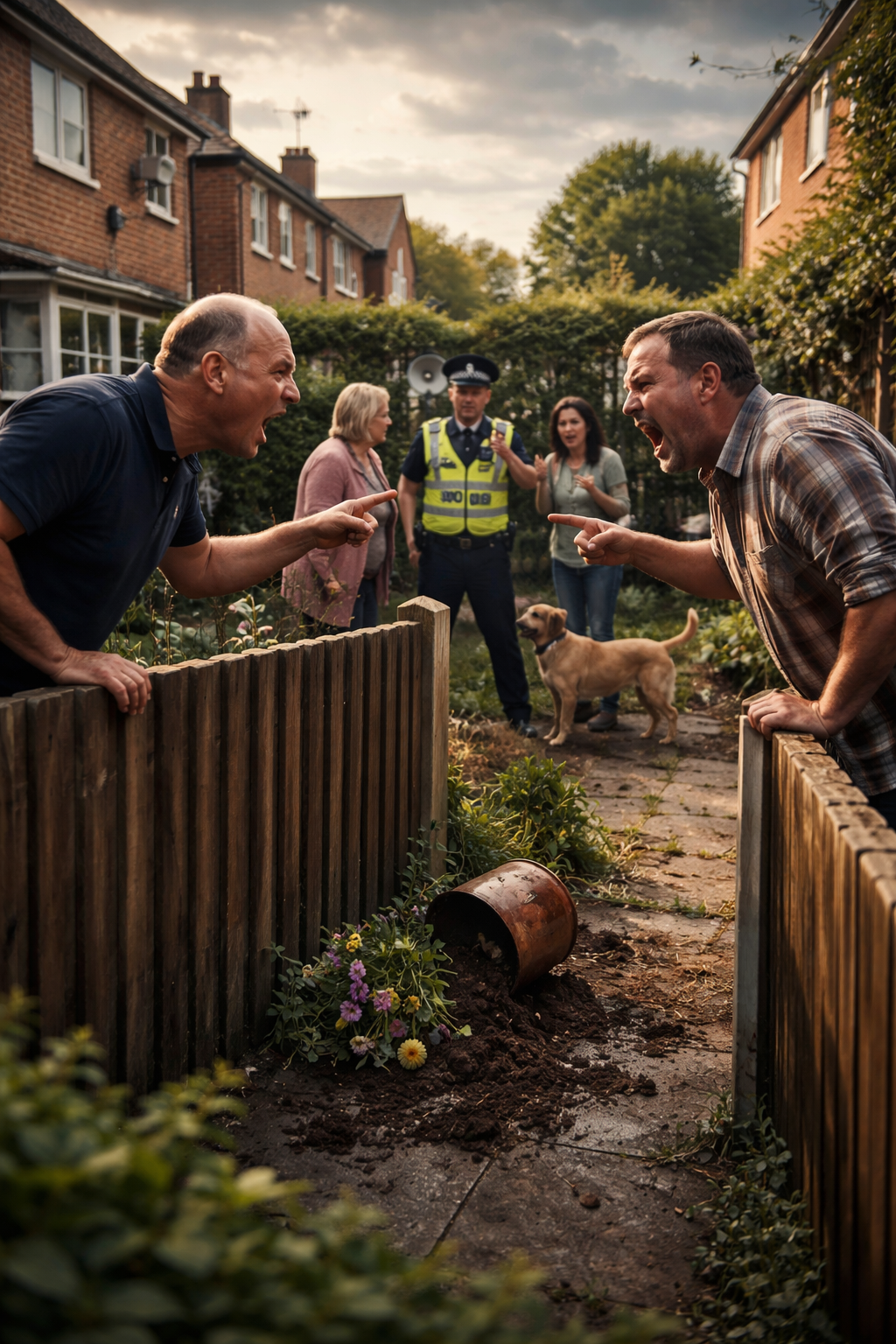
WHEN FENCES FAIL: THE QUIET BATTLEFIELD OF THE QUIET BRITISH BATTLEFIELD OF NEIGBOURS
When the garden fences marks an enemy line, your home life can turn into a living hell
— Nightmare Neighbour Channel 5
There is a particular kind of British reality show that unfolds across hedges, over garden fences, and through paper-thin walls.
Nightmare Neighbour Next Door, the Channel 5 series that quietly built a reputation for jaw-dropping realism, shines a light on a truth many would rather keep behind closed curtains: the fiercest feuds are often the closest to home.
This is not the stuff of polite disagreements over borrowed sugar. These are slow-burning conflicts, simmering for months or years, where the smallest spark, a barking dog, a late-night playlist, a car parked six inches too far, can ignite something far more volatile. One memorable dispute spiralled from something as trivial as a flower pot placed on the “wrong” side of a driveway. A pot. Soil and ceramic. Yet behind it, pride, territory, and resentment bloomed into something far uglier.
The programme captures a peculiar tension in British life: the cultural instinct to avoid confrontation, paired with a deep attachment to personal space. When those two collide, silence turns into passive aggression, passive aggression into hostility, and hostility, at its worst, into outright conflict. Viewers are left watching what feels less like entertainment and more like a social autopsy.

What becomes clear is that disputes rarely begin with shouting. They begin quietly. A note through the letterbox. A muttered complaint. A glance held a second too long. Over time, grievances calcify. The neighbour is no longer “the chap next door” but an antagonist, a daily irritation, a presence that cannot be escaped.
Land is often the battleground. A fence moved inches off course can feel like an invasion. Pets become proxies in these conflicts, with barking dogs or wandering cats transforming into symbols of disrespect. Noise, that invisible intruder, is perhaps the most common culprit, music too loud, too late, too frequent. Then there are the more modern tensions: home renovations, extensions blocking light, or the slow creep of urban living where space is scarce and tempers even scarcer.
Yet what makes Nightmare Neighbour Next Door particularly sobering is not just the disputes themselves, but the limitations of those tasked with resolving them. Police intervention, as the series frequently highlights, is not a first port of call but a last resort. Officers typically step in only when a clear criminal offence has occurred, harassment, threats, or violence. Until then, many residents are left in a grey zone of frustration.
Housing associations and local councils, meanwhile, operate on evidence. Complaints alone are not enough. Residents are often asked to keep detailed logs of disturbances, record noise levels, gather witness statements. It is a bureaucratic hurdle that can feel insurmountable to those already worn down by daily stress. Solicitors, too, require tangible proof before any legal route can be pursued. In essence, the burden of proof rests heavily on those already feeling wronged.
And so the disputes linger. They stretch on, sometimes for years, turning homes, the very places meant for comfort and refuge, into arenas of tension. The programme does not shy away from the darker outcomes. In some cases, arguments escalate into physical confrontations, property damage, or long-term psychological strain. It is a stark reminder that proximity does not always breed harmony; sometimes, it breeds hostility.
What Nightmare Neighbour Next Door ultimately reveals is not just conflict, but a fragile social contract. Neighbourliness, once an unspoken code of mutual respect, now seems increasingly strained in a world where space is tighter, patience thinner, and lifestyles more divergent.
The irony is almost poetic. We build walls to define our boundaries, yet it is those very boundaries that so often become the fault lines of dispute.
In the end, the series leaves viewers with an uncomfortable question: how well do we really know the people living just a few feet away? And perhaps more importantly, how easily could a minor irritation tip the balance from civility into chaos?
Because as the programme makes abundantly clear, it doesn’t take much. Not a party. Not a building project. Not even a feud of long standing.
Sometimes, all it takes is a flower pot.


