
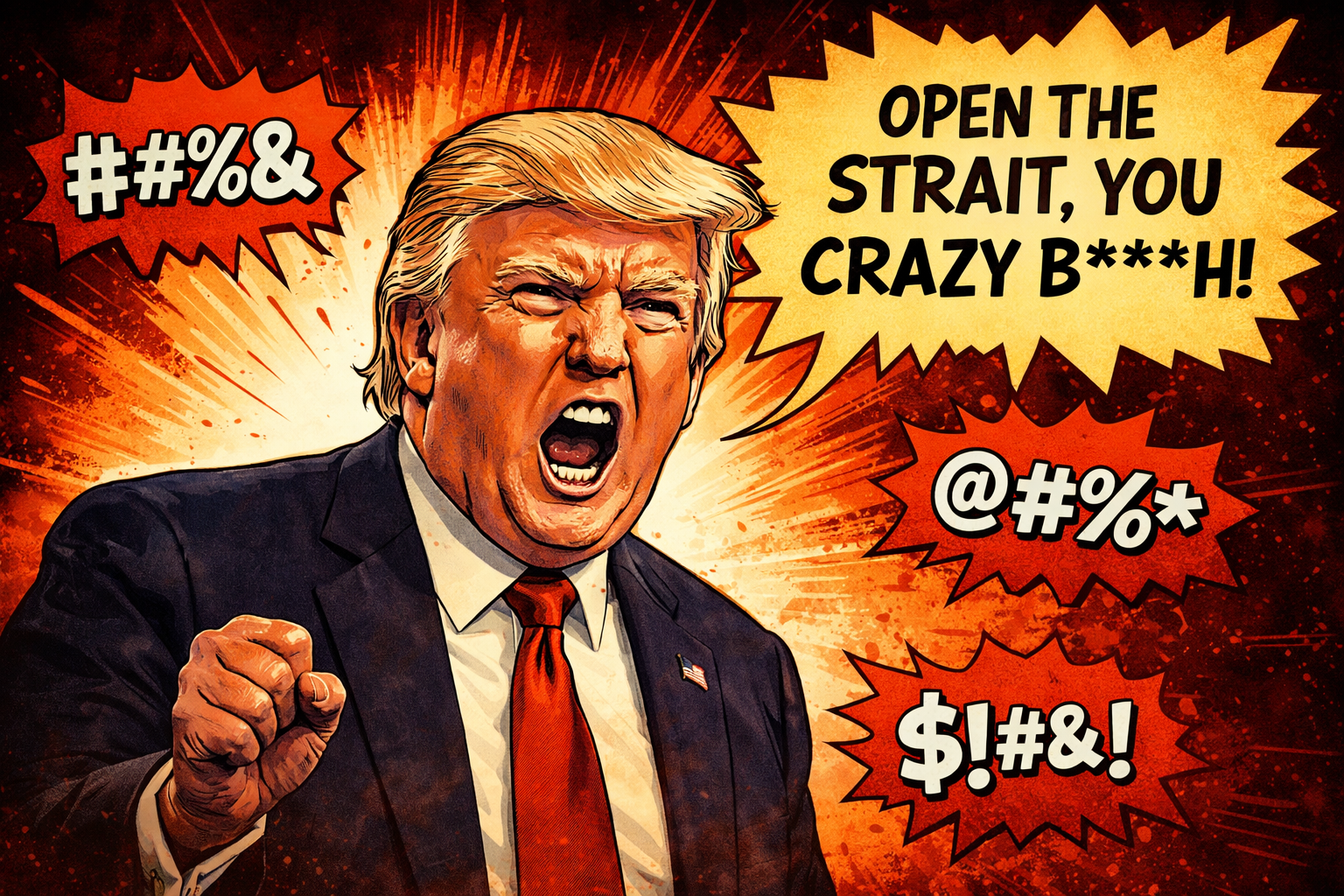
Broadcast apology, global alarm, and a crisis teetering between diplomacy and detonation.
A routine broadcast on Sky News veered into extraordinary territory when US correspondent James Matthews was forced to apologise live on air after reading out an explosive message from Donald Trump.
The message, posted on Truth Social, contained explicit language rarely — if ever — heard from a sitting US president in public diplomacy.
Viewers watched as Matthews paused, then continued, before issuing an apology for the language he had just repeated verbatim.
THE TWEET THAT SHOOK DIPLOMACY
At the centre of the storm was Trump’s ultimatum to Iran over the Strait of Hormuz — a vital artery for global oil shipments:
“Tuesday will be Power Plant Day, and Bridge Day, all wrapped up in one, in Iran. There will be nothing like it!!! Open the F*****’ Strait, you crazy b*****ds, or you’ll be living in Hell — JUST WATCH!”
— President Donald Trump
The language — raw, confrontational, and laced with threats — sent immediate shockwaves through diplomatic circles.
“UNHINGED” PRESIDENT UNDER FIRE
Matthews delivered a scathing assessment, suggesting the tone of the message betrayed a leader “losing the argument” and reaching for “darker methods” in an increasingly entrenched conflict.
He warned that such rhetoric tears at the fabric of diplomatic norms, raising serious concerns about judgement at a moment requiring precision, not provocation.
In a striking line, he concluded the post “sounds unhinged” — a remark that has since echoed far beyond the studio.

ALLIES RECOIL AS WORLD LEADERS URGE RESTRAINT
Across global capitals, the reaction was swift — and uneasy.
In United Kingdom, officials called for calm, warning that language of this nature risks lighting the fuse of a wider conflict.
France and Germany pushed for immediate de-escalation, stressing that diplomacy cannot function through threats shouted into the void of social media.
China urged “maximum restraint,” highlighting the fragile state of global energy markets.
Russia went further, condemning the remarks as reckless and destabilising.
Even traditionally aligned nations appeared unsettled, with one diplomat describing the post as “petrol poured on a live wire.”

WASHINGTON BACKPEDALS — BUT QUESTIONS LINGER
The White House has since sought to distance itself from the tone of the message, insisting no formal military escalation has been authorised.
Yet the contradiction is stark: threats of devastation on social media, paired with claims that negotiations with Iran remain ongoing.
The result is confusion — and a dangerous ambiguity that leaves allies guessing and adversaries calculating.
A STRAIT ON EDGE — AND A WORLD HOLDING ITS BREATH
Meanwhile, Iran remains defiant, resisting pressure and signalling that any movement on reopening the Strait will require broader concessions.
Below the rhetoric, reality hardens: oil tankers idle, markets tremble, and the narrow stretch of water becomes a stage for global tension.
WORDS THAT ECHO LIKE WAR DRUMS
In another era, diplomacy moved at the speed of cables and carefully chosen phrases. Now, it can arrive in capital letters, punctuated with expletives, and read aloud — apologetically — on live television.
The danger is not just what is said.
It’s what follows.


