
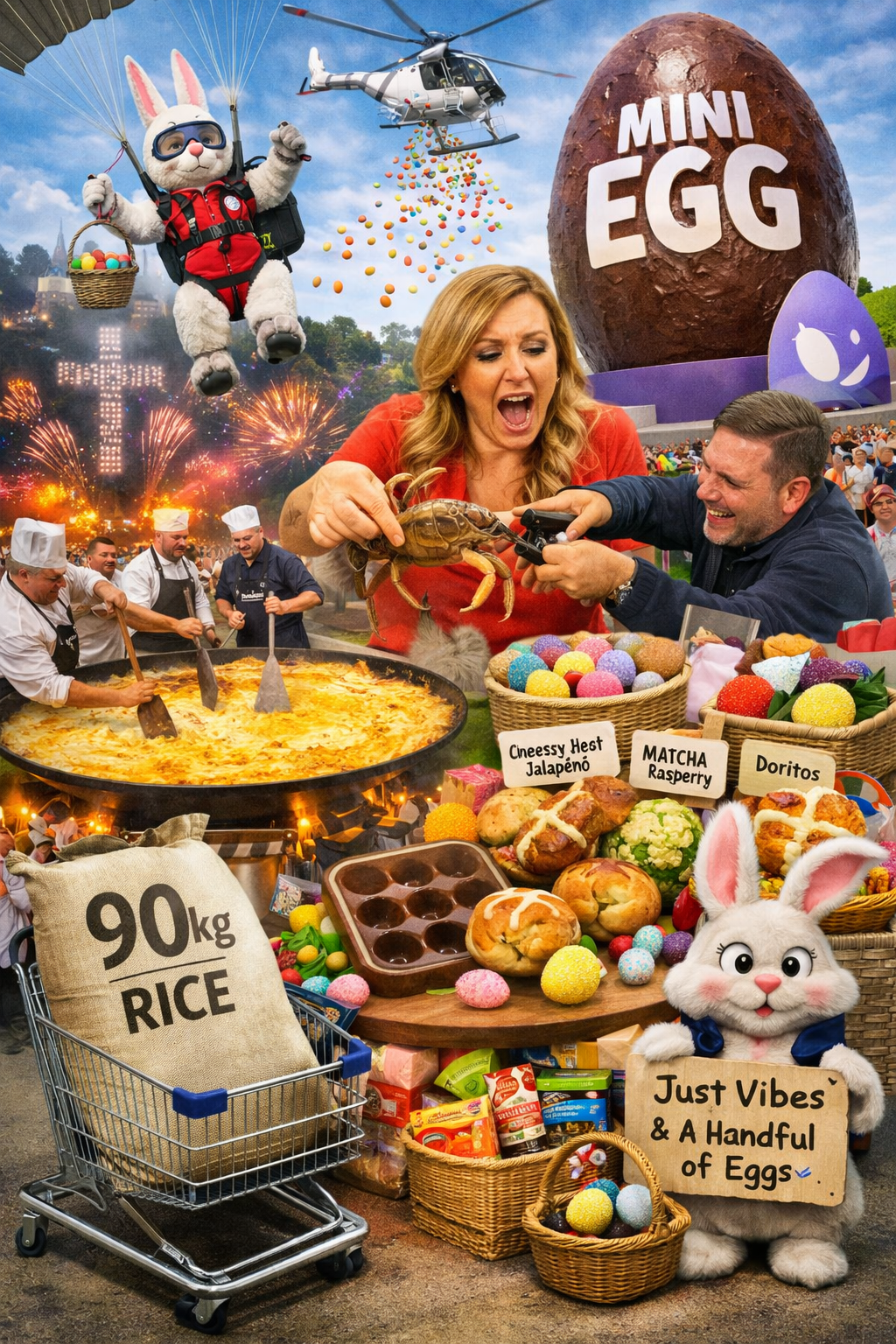
From airborne chocolate drops to a televised crustacean rebellion, this year’s celebrations prove the world still knows how to laugh—even when the eggs are getting smaller.
FAITH MEETS FIREWORKS (AND THE OCCASIONAL DRONE)
Easter, that ancient pillar of reflection and renewal, has in some places traded quiet hymns for something closer to a blockbuster premiere.
Across parts of the United States, churches have taken a bold swing at modern engagement, turning the story of resurrection into a full sensory experience. And some religious festivals like ‘Hillsong’ have used drone lighting over their Easter 2026 performances.
Skydiving Easter Bunnies have descended from the heavens with theatrical flair, while helicopters have scattered tens of thousands of eggs over eager crowds below. In one coordinated spectacle, drones lit up the night sky alongside fireworks, narrating the Easter story through light and sound.
It is, depending on your mood, either a dazzling reinvention of tradition or Easter directed by Hollywood. Either way, it has succeeded in one mission: people are watching again.
THE CRAB THAT REFUSED TO COOPERATE
Meanwhile, in Australia, Easter delivered a moment of pure, unscripted comedy. A television weather presenter, attempting a playful segment involving seafood, leaned in to kiss a crab.
Speaking to seafood seller Mike at the Sydney Fish Markets in Glebe, AU, on Friday morning, weather presenter Taylor Haynes was keen to explore the seafood available for the Easter long weekend.
The crab, unimpressed by broadcast etiquette, clamped down on her finger and refused to let go.
What followed was live television at its most chaotic: a presenter half-laughing, half-wincing, as efforts were made to detach the indignant crustacean using a metal rod. The segment quickly transformed from light entertainment into a gripping, if slightly absurd, survival drama.
THE GREAT EASTER EGG VANISHING ACT
Back in shops across the UK and beyond, a quieter but no less noticeable phenomenon has been unfolding.
Easter eggs, once proudly substantial, appear to have entered a slimming programme no one signed them up for.
Consumers have reported that eggs are shrinking while prices climb, the result of rising cocoa costs and ongoing supply pressures. Shelves still gleam with foil and promise, but many shoppers suspect they are buying more air than chocolate.
It is a peculiarly modern kind of disappointment. The packaging remains almost grand and unchanged and the expectation intact, but the reality feels just a little lighter in the hand.
A “MINI” EGG THAT DEFIES LOGIC
In delicious contrast to the shrinking trend, one creation has gone in entirely the opposite direction. At Cadbury World, chocolatiers unveiled a so-called “Mini Egg” weighing in at a staggering 121 pounds.
The name alone feels like a quiet joke. There is nothing miniature about a chocolate egg that could double as gym equipment. Yet it stands as a reminder that, somewhere amid economic restraint, excess still finds a way to bloom.
FRANCE’S GIANT OMELETTE TRADITION
Elsewhere in Europe, Easter continues to embrace its more communal, culinary side. In a French town known for its devotion to spectacle, thousands gather each year to prepare a single enormous omelette using around 15,000 eggs.
The dish is cooked in a pan vast enough to resemble industrial equipment, stirred with tools more commonly associated with construction than cuisine. The result feeds entire crowds, turning breakfast into a public celebration.
It is less a meal and more a ritual of abundance, where the simple egg becomes something almost mythic in scale.
WHEN THE EASTER BUNNY NEARLY RAN EMPTY
Not all stories this year have been light-hearted from the outset. In Australia, a charity warned that without urgent donations, the Easter Bunny might arrive with little more than “good vibes and a handful of eggs.”
The phrasing, humorous and slightly desperate, struck a chord. Donations flooded in, transforming what could have been a bleak holiday into a reminder of collective generosity.
Even in an age of distraction, it seems a well-timed joke can still open wallets—and hearts.
HOT CROSS BUNS GO OFF THE RAILS
And then there are the buns. Once modest, spiced, and dependable, hot cross buns have entered an era of culinary experimentation that borders on rebellion.
Supermarkets have rolled out flavours ranging from cheese and jalapeño to matcha and even snack-inspired hybrids. The traditional recipe still exists, of course, but it now shares shelf space with creations that feel as though they were conceived during a particularly daring brainstorm.
Whether this is innovation or chaos depends entirely on your palate.
A SEASON THAT REFUSES TO SIT STILL
Taken together, these moments form a portrait of Easter in 2026: a festival balancing reverence with reinvention, tradition with spectacle, and sincerity with a surprising amount of comedy.
There are still quiet churches and candlelit services. There are still families gathering, stories retold, meanings preserved. But alongside them, there are skydiving rabbits, rebellious crabs, and chocolate eggs that either shrink into disappointment or expand into absurdity.
Easter, it seems, has not lost its meaning. It has simply gained a sense of humour.


