
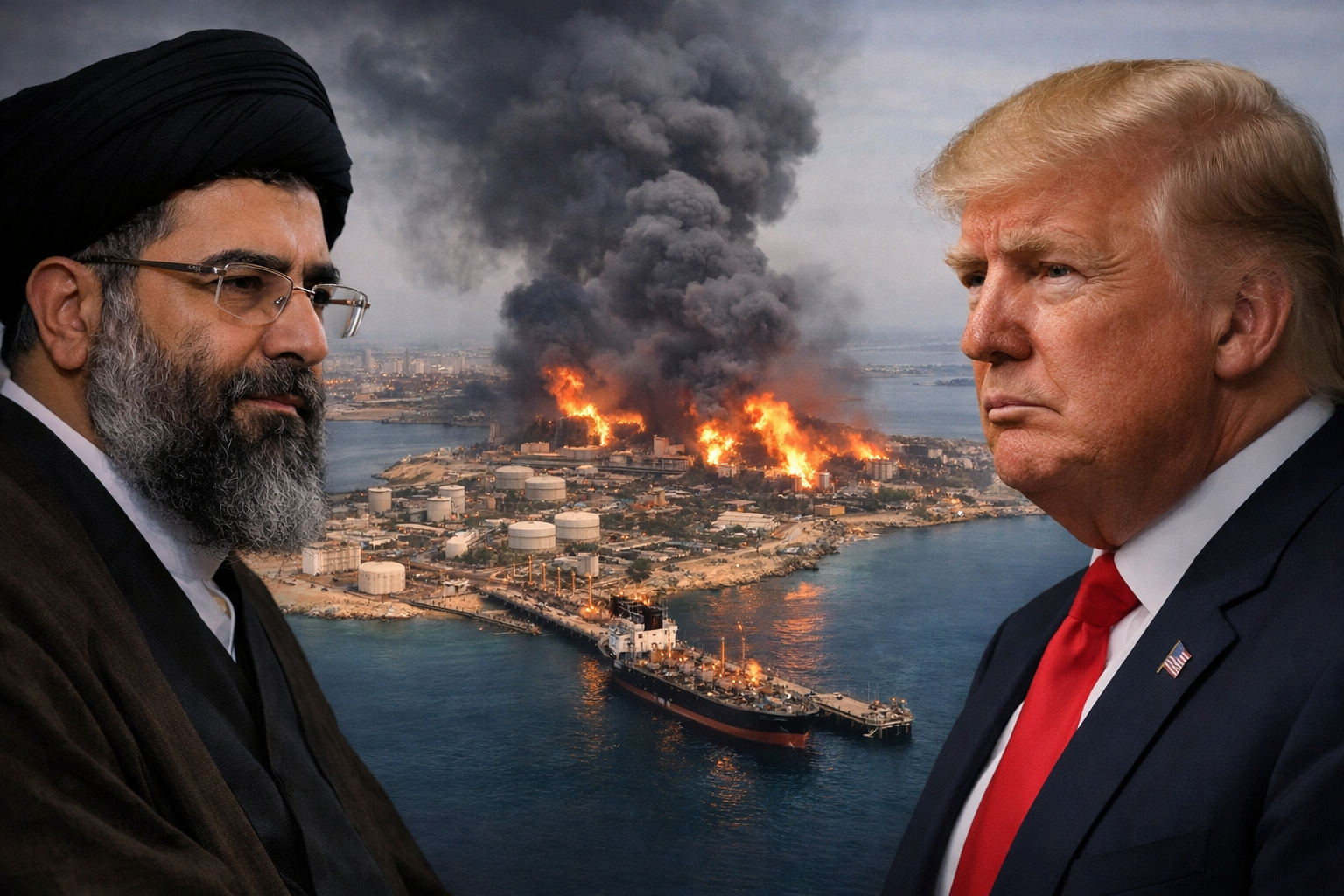
Iran has issued a stark warning to Washington as thousands of additional American troops arrive in the Middle East, raising fears that the conflict could tip into a dangerous new phase involving ground operations and critical energy infrastructure.
Speaking through state media, parliamentary speaker Mohammad Bagher Ghalibaf declared that Iranian forces were poised for confrontation, vowing a fierce response should US troops set foot on Iranian soil. He accused Washington of duplicity, claiming it speaks publicly of diplomacy while quietly preparing for escalation.
US Build-Up Signals Expanding Military Options
The latest deployment of roughly 3,500 American personnel, including marines and naval forces attached to the amphibious assault ship USS Tripoli, underscores the growing military pressure around Iran.
While officials have stopped short of confirming a ground invasion, reports from US media suggest the Pentagon is preparing for sustained operations that could last weeks. These plans are believed to centre on targeted raids involving conventional troops and elite special forces, rather than a full-scale occupation.
At the same time, American firepower in the region has swelled. Strategic bombers, fighter aircraft, missile defence systems and carrier groups are now positioned across key نقاط of the Middle East theatre, forming a tightening ring around Tehran.
Trump’s Mixed Signals: War or Deal?
President Donald Trump has delivered a characteristically shifting message on the trajectory of the war. At times he has suggested the conflict is nearing its end; at others, he has openly contemplated intensifying military action, including strikes on Iran’s energy sector.
In remarks at the White House, Trump insisted he had no intention of committing ground forces, before adding a pointed caveat: if he did, he would not announce it in advance.
Meanwhile, Secretary of State Marco Rubio indicated that while US objectives might be achieved without boots on the ground, contingency planning remains firmly in place.
Behind the scenes, the administration is reportedly seeking as much as $200 billion in emergency funding from Congress, a signal that Washington may be preparing for a prolonged campaign rather than a rapid exit.
The Shadow of Diplomacy
Confusion also surrounds the state of diplomatic efforts. Tehran has denied engaging in formal negotiations, though Foreign Minister Abbas Araghchi acknowledged indirect exchanges via intermediaries.

Washington paints a very different picture. Trump has claimed talks are progressing “very well,” even suggesting Iranian leaders are reluctant to admit it publicly for fear of domestic backlash.
At the centre of these alleged discussions is a reported 15-point US proposal, transmitted through посредники including Pakistan. Though unpublished, it is said to bundle longstanding American and Israeli demands, most notably the dismantling of Iran’s nuclear programme.
Iran, in turn, has set out its own conditions: recognition of its authority over the Strait of Hormuz, compensation for wartime damage, and the withdrawal of US military bases from the region.
Kharg Island: The Crown Jewel of the Conflict

Amid the strategic manoeuvring, one location has emerged as a potential decisive objective: Kharg Island, Iran’s primary oil export hub.
Kharg Island isn’t just another dot in the Gulf. It’s the beating heartbeat of Iran:
Around 90% of Iran’s oil exports flow through it. Kharg Island acts as the main bridge between oil fields and global markets.
The area generates tens of billions in state revenue for the Iranian government.
Handling the vast majority of Iran’s crude exports, the island sits like a valve on the global oil market. Any attempt to seize or disable it would strike directly at Tehran’s economic lifeline while sending shockwaves through global energy supplies.
Trump has openly floated the idea of targeting Iran’s oil assets, even suggesting the United States could “take the oil” – language that has alarmed analysts and drawn comparisons to past conflicts over resource control.
Military planners are believed to be assessing scenarios ranging from precision strikes on infrastructure to a temporary occupation of the island by US forces. Such a move would represent a dramatic escalation, effectively placing a chokehold on Iranian exports.
A War Already Taking Its Toll
The conflict, which erupted with US and Israeli strikes on 28 February, has already inflicted heavy casualties. Among the dead is Iran’s Supreme Leader Ali Khamenei, alongside several senior officials. Civilian losses have climbed into the thousands, according to monitoring groups.
Iran’s retaliation has been swift and disruptive, with missile attacks targeting Israel and US bases across the region. The result has been widespread instability, including major disruption to international air travel routes.
Global markets have reacted sharply. Oil prices have surged beyond $115 per barrel, while fears are mounting over rising food costs as fertiliser exports become increasingly constrained.
Global Ripples Reach Britain
In the UK, Prime Minister Keir Starmer is expected to convene business leaders in Downing Street to assess the economic fallout. The concern is clear: a prolonged conflict could feed directly into higher living costs, compounding existing pressures on households.
The Road Ahead
For now, the war sits at a volatile crossroads. Washington holds overwhelming military superiority, yet faces the prospect of deeper entanglement. Tehran, wounded but defiant, signals it is ready to escalate further if provoked.
At the centre of it all lies Kharg Island, a small stretch of land with outsized importance, where oil, power, and geopolitics collide. Whether it becomes the decisive battlefield or a bargaining chip in last-minute diplomacy may determine not just the fate of this war, but the stability of the global economy itself.


