
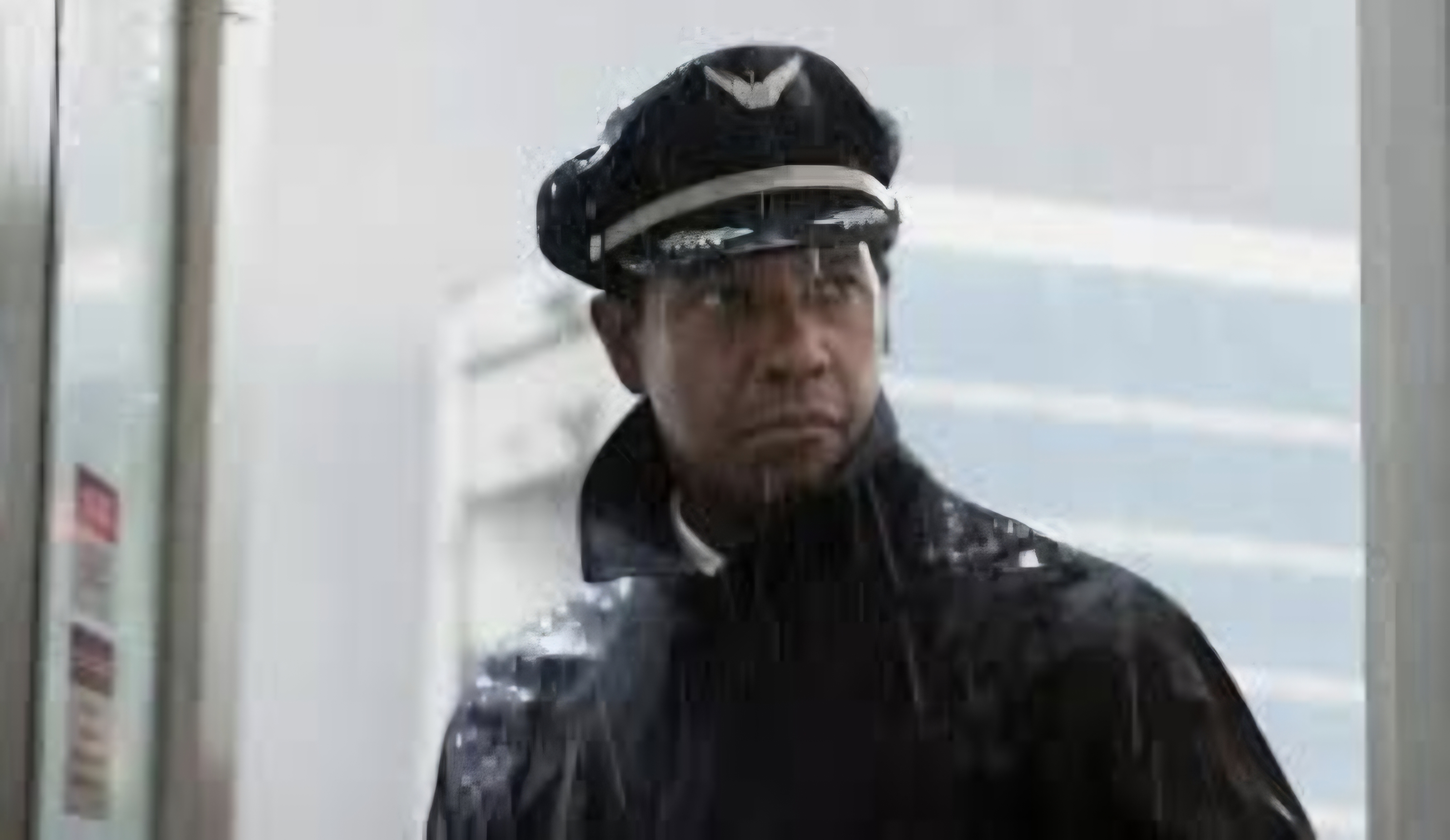
When the Hero Is the Problem: Revisiting Flight and Its Sobering Truth
Directed by Robert Zemeckis and starring Denzel Washington in a performance of considerable depth, Flight (2012) remains a noteworthy contribution to contemporary cinema more than a decade after its release.
The film masterfully blends the intensity of a disaster thriller with a profound character study, exploring themes of personal responsibility, denial, and the possibility of recovery.

The narrative opens with a gripping sequence aboard SouthJet Flight 227. Following a night of heavy alcohol consumption and cocaine use, pilot Whip Whitaker (Washington) faces a catastrophic mechanical failure that plunges the aircraft into a steep nosedive.

In a display of exceptional skill and presence of mind, Whitaker executes an extraordinary maneuver: inverting the plane completely to stabilize its descent, gliding it inverted over open terrain before crash-landing in a rural churchyard.
This act saves 96 lives, though six are lost. The heroism is undeniable, yet subsequent toxicology reports confirm Whitaker’s intoxication at the time of the incident, establishing the central moral tension of the film.
Washington portrays Whitaker as a talented but deeply troubled individual whose professional prowess has long masked his substance abuse.

Initially, he embraces denial, attributing the crash solely to mechanical issues and rejecting any suggestion of personal culpability.
Supported by his union representative (Bruce Greenwood) and legal counsel (Don Cheadle), he attempts to conceal evidence of his impairment. His relationships—with his estranged ex-wife, his son, and a fellow recovering addict, Nicole (Kelly Reilly)—further highlight the destructive reach of his addiction.
A standout supporting performance comes from John Goodman as Harling Mays, Whitaker’s longtime friend and supplier. Mays appears in limited but impactful scenes, arriving with provisions of alcohol, cocaine, and other indulgences during Whitaker’s moments of crisis.
His most memorable appearance occurs in a hotel room sequence prior to a critical hearing, where he energizes Whitaker with a rhythmic, almost incantatory pep talk set to the Rolling Stones’ “Sympathy for the Devil.”
Lines such as “Take it all in, that’s the banana man, dude!” and exhortations to “focus up, big dog” encapsulate Mays’s role as an enabler whose chaotic enthusiasm provides temporary relief while perpetuating the cycle of dependency.

Goodman’s portrayal infuses these moments with dark humor and undeniable charisma, offering brief respite from the film’s heavier tone.
The film’s salient issue lies in its unflinching depiction of alcoholism and the journey from denial to acceptance.
Whitaker’s arc traces a gradual shift: from rationalizing his behavior and manipulating circumstances to preserve his image, to confronting the truth under mounting pressure.
The pivotal NTSB hearing marks the turning point, where Whitaker, having resisted perjury, publicly acknowledges his condition: “I am an alcoholic.” This admission, delivered with raw vulnerability by Washington, proves transformative.

Subsequently, the narrative moves toward sobriety and accountability. Whitaker engages with support structures, including Alcoholics Anonymous meetings, and begins to rebuild fractured relationships.
The film concludes on a note of qualified hope: incarceration provides the structure for reflection, and Whitaker finds a measure of freedom through honesty.
Flight ends not with triumph but with something more realistic. Whitaker loses his freedom, yet gains a different kind of liberation through honesty and sobriety. Zemeckis wisely resists easy redemption, instead offering a closing note of reflection and hope.
It underscores that professional skill—however remarkable—cannot indefinitely shield one from the consequences of untreated addiction, and that genuine recovery requires humility, truthfulness, and community.
Flight succeeds as both an aviation thriller and a serious exploration of human frailty. Zemeckis directs with precision, balancing spectacle with introspection, while Washington’s nuanced performance anchors the emotional core.
Goodman’s brief but vivid contribution adds levity without undermining the gravity of the subject matter.
The film’s enduring message—that even those who achieve extraordinary feats in crisis may require profound personal intervention—resonates as a reminder of the complexities of addiction and the redemptive power of self-honesty.
A film of considerable merit, Flight invites repeated viewings to appreciate its layered portrayal of heroism intertwined with vulnerability.


