
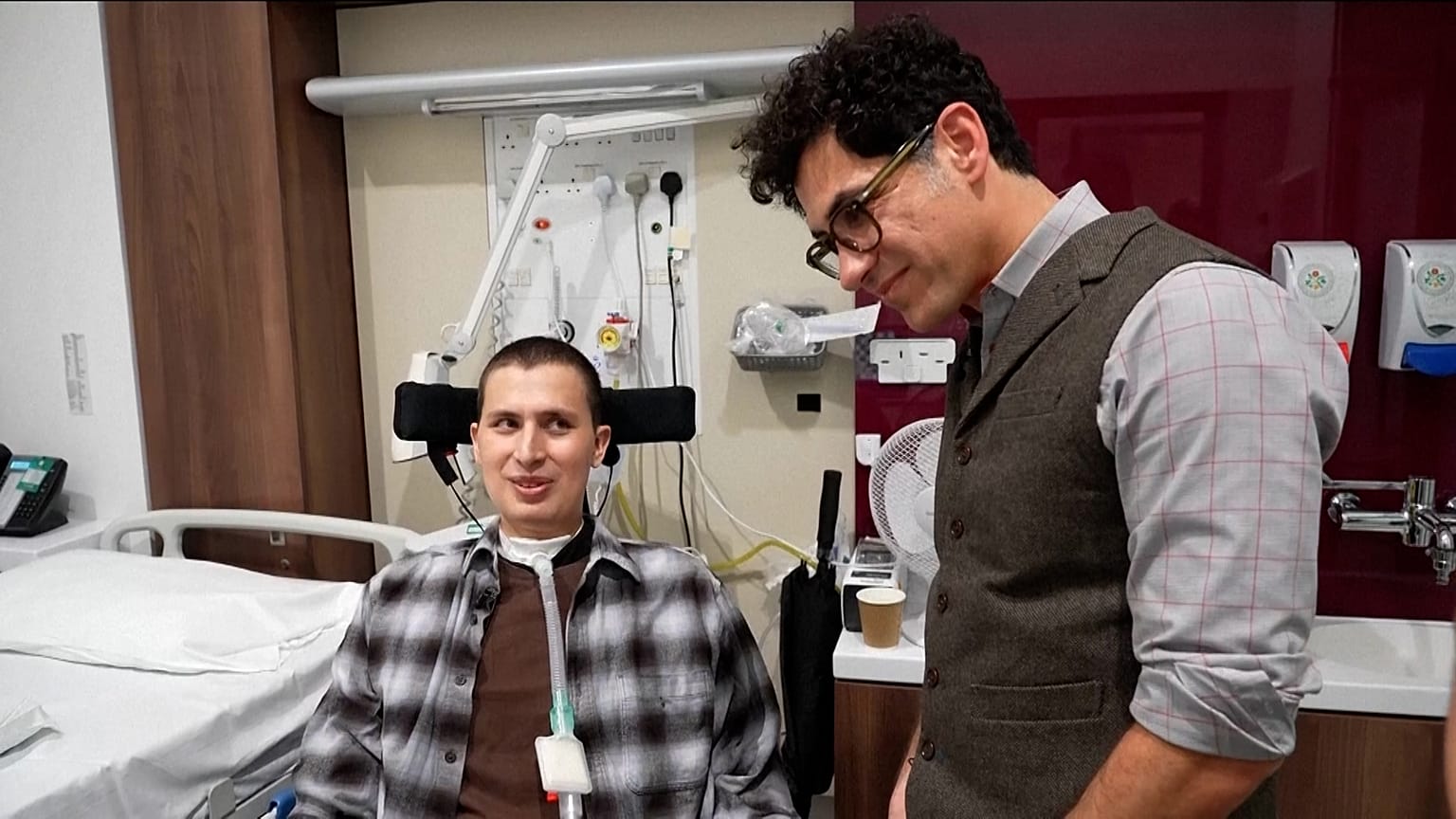
A pioneering British participant in the UK’s first trial of Elon Musk’s Neuralink brain implant has described the experience as feeling “magical,” saying it has restored a profound sense of hope for people living with severe paralysis.
Sebastian Gomez-Pena, who became paralysed from the neck down following a tragic accident shortly after starting medical school, is among seven individuals implanted with the device in the ongoing UK study.

The trial, led by University College London Hospital (UCLH), aims to evaluate the safety and effectiveness of the technology developed by Musk’s company, Neuralink.
The implant procedure, which lasted around five hours at UCLH, involved a combination of British surgeons, Neuralink engineers, and the company’s advanced R1 surgical robot.
The robot precisely inserted 1,024 ultra-thin electrodes—each roughly one-tenth the width of a human hair—about 4mm into the brain region responsible for controlling hand movements.

The chip itself sits flush within a small circular opening in the skull, wirelessly transmitting neural signals to external devices.
Artificial intelligence software interprets Seb’s brain activity in real time. When he thinks about moving his hand or tapping a finger, the system translates those intentions into cursor movements or mouse clicks on a connected computer—effectively bypassing the damage to his spinal cord.
“It’s incredible,” Seb explained. “People in my situation often try to twitch or move something, hoping for any sign of recovery. Now, when I simply think about moving my hand, I see real results on the screen. You just intend it, and it happens.”
During a recent check-up, I observed Seb navigating a laptop with remarkable speed and precision—flipping through research papers, highlighting text, and managing windows faster than many able-bodied users could with a traditional mouse or trackpad.
Neurosurgeon Harith Akram, the trial’s lead investigator at UCLH, described the level of control as “mind-blowing.” While still in its early stages, the technology has already shown encouraging results.
Neuralink’s journey to human trials spanned nearly a decade, involving development of the chip, electrodes, robotic surgeon, and AI decoding tools.

The first human implant occurred in the US two years ago; today, 21 people across the US, Canada, the UK, and UAE live with the device, all dealing with severe paralysis from spinal injuries, strokes, or conditions like ALS.
Full peer-reviewed data from the trials have not yet been published, and Neuralink declined requests for interviews, though the company permitted access to the UK study.
Akram remains optimistic: “This has the potential to be transformative for those with profound neurological disabilities. In a world so reliant on digital tools, restoring even basic independence through thought alone could change lives dramatically.”


