
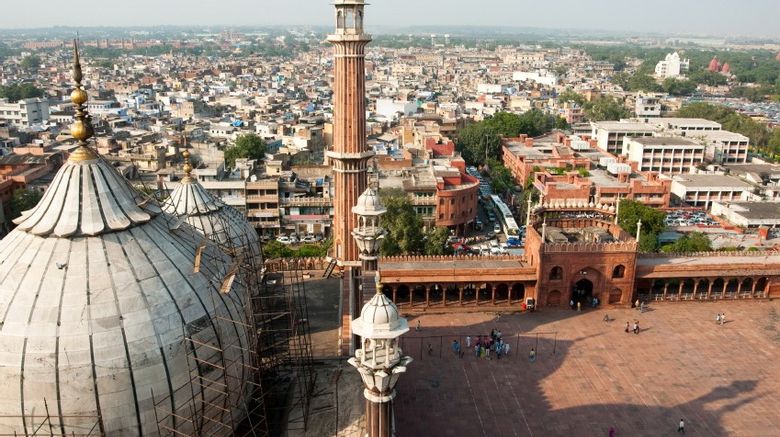
HOW INDIA’S CAPITAL SURGED PAST TOKYO TO BECOME ONE OF THE WORLD’S MOST DENSELY POPULATED MEGACITY AND THE SECOND LARGEST METROPOLITAN AREA IN THE WORLD
By Cicero & ChatGPT
The world’s urban crown has shifted east — and with thunderous footsteps. New Delhi, already one of the most intense human landscapes on the planet, has now officially one the most densely populated major cities on Earth, according to the latest international urban population estimates.
It’s not just a demographic milestone. It’s a seismic economic, social, and geopolitical signal — the sound of India’s urban engine revving into a new historical gear.

A CITY THAT NEVER STOPS ARRIVING
New Delhi’s growth is driven by a relentless tide of internal migration. Millions arrive each year from rural states, drawn by work in construction, manufacturing, transport, retail, IT services, and government. The city doesn’t so much expand as compress, stacking humanity tighter and tighter into its expanding metropolitan web.
Housing strains under the pressure. Informal settlements swell. Infrastructure creaks. Yet the magnet never weakens — because opportunity, even when crowded, still shines.


THE ECONOMIC PULSE OF A RISING POWER
New Delhi is not just a political capital — it is a trade and economic nerve centre:
A major hub for technology services, telecoms, finance, pharmaceuticals, and manufacturing
Deep trade links with the Gulf states, Southeast Asia, Africa, Europe, and North America
A central command point in India’s role within the global supply chain realignment away from over-dependence on China
Exports of software services, medical products, engineering parts, and digital infrastructure now flow outward while raw materials, energy, and advanced components flow inward. The city is both marketplace and command bridge.
In short: density is powering velocity — economic speed born from human concentration.

THE RIVALS: SHANGHAI, JAKARTA — AND THE CHINESE SUPER-CITY MACHINE
While New Delhi takes the density crown, it does not stand alone in the megacity age.
Shanghai remains one of the world’s most powerful urban economies — a manufacturing, finance, and shipping colossus plugged directly into global trade arteries. Its sheer area diffuses density, but its economic gravity is immense.
Jakarta, once the undisputed density champion, still surges with life and trade. But climate pressure, flooding, and the partial relocation of Indonesia’s capital have slowed its explosive rise.
And then there is China itself — building entire super-city clusters rather than single megacities:
The Greater Bay Area linking Hong Kong, Shenzhen, and Guangzhou
The Yangtze River Delta centred on Shanghai
The Beijing–Tianjin–Hebei megaregion
These are not cities in the old sense — they are urban continents, designed to dominate manufacturing, tech, logistics, and AI for the next half-century.
THE FUTURE IS DENSE, FAST — AND UNFORGIVING
This is the new global pattern:
Not just big cities — but compressed super-engines of humanity.
New Delhi now stands as the most concentrated example of this age:
Explosive population
Young workforce
Rising digital economy
Crushing environmental and housing pressures
It is both a triumph of human motion and a warning siren of urban overload.
The 21st century will not be ruled by nations alone. It will be ruled by cities so vast they bend economics, climate, and politics around them.
And right now, at the centre of that human storm, stands New Delhi — louder, denser, and more consequential than any city before it.


