
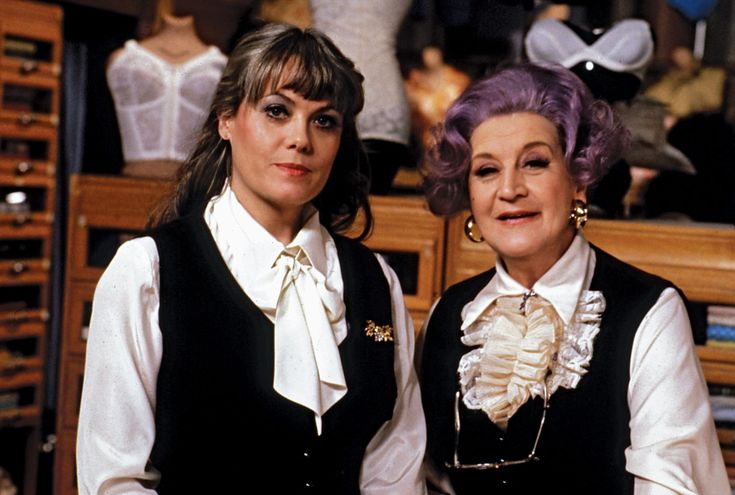
“They Were Being Served”: The Women Who Shaped British Comedy
By Cicero for Ciceros.org
They were cheeky, they were bold, and they were national treasures long before the phrase was fashionable.
Wendy Richard, Mollie Sugden, Yootha Joyce, and Dame Barbara Windsor etched their names into the British comedy pantheon like lipstick on a department store till.
Through sitcoms, soaps, and side-splitting farce, these women defined a generation, not just as comic relief, but as icons who navigated the laughter and the darkness, both on-screen and off.
Wendy Richard: From Brahms to Battleaxe
Wendy Richard may be best remembered for her years behind the counter as Miss Shirley Brahms in Are You Being Served?, but her career spanned much more than bouffants and blouses.
A Cockney girl by voice and by virtue, she first charmed the nation in Dad’s Army as the spirited Shirley, a working-class East End girl who caught the eye of Private Walker. Her performance had warmth and grit — a sign of things to come.
However, it was in EastEnders that she truly defied expectations by portraying the strong-willed Pauline Fowler. Decades of “silly blonde” roles were suddenly cast aside — here was a woman weighed down by hardship, family duty, and quiet resilience. The critics who once giggled at Miss Brahms now applauded. Wendy had made them take her seriously.

She also battled breast cancer twice in her life, fighting with the same determination as the characters she portrayed. She passed away in 2009, leaving a lasting legacy as the vibrant heart of Albert Square.
Mollie Sugden: The Cat’s Meow
“Oh, I’m not myself today. My pussy’s been terribly moody.”

Only Mollie Sugden, with her impeccable dignity and twinkling eyes, could deliver such a line. As Mrs. Slocombe, she turned Are You Being Served? into a masterclass of innuendo-laden brilliance.
Yet behind the wigs and double entendres was a classically trained actress who spent years on stage and in radio. Mollie’s real genius was elevating the absurd—she gave pathos to preposterousness.
She also portrayed the everyday battles of working-class women with flair. Her character might have been obsessed with her feline companion, but she also embodied pride, survival, and self-worth in a man’s world—whether in Grace Bros or 1970s Britain.
Yootha Joyce: The Bitter Truth Behind the Laugh
Elegant, sharp, and unspeakably witty—Yootha Joyce was the ultimate scene-stealer. Her role as Mildred Roper in Man About the House and its spin-off George and Mildred turned her into a household name.
Behind her caustic remarks and tragicomic sighs was a deeply sensitive soul. Yootha’s personal life was marked by silent suffering — particularly her battle with alcohol. She died tragically in 1980 from liver failure, aged just 53.

Her passing shocked the industry. She was so loved and polished on screen that few realised the extent of her private despair. But her legacy lingers — not just in the laughs she left behind, but in the way she gave life to complicated women. Mildred wasn’t just funny — she was lonely, longing, layered.
Dame Barbara Windsor: From Carry On to Carry On Regardless
No one could deliver a wink like Barbara Windsor. In the Carry On films, she was the pint-sized blonde bombshell, the playful face of a new, naughty Britain. But Barbara was far more than a saucy gag and a shriek.

Trained at the prestigious Aida Foster stage school, Barbara honed her skills in variety and repertory before achieving film fame. Yet the later years were not so kind: many of her Carry On co-stars fell into poverty or obscurity. Barbara kept going, carrying their stories with her.
Her crowning second act came as Peggy Mitchell in EastEnders, where she transformed from icon to institution. “Get outta my pub!” became a rallying cry for working-class women who had maintained family unity in post-war London.
Knighted in 2016, Dame Barbara spent her final years campaigning for dementia awareness before her passing in 2020. Even in death, she carried on — in the hearts of millions.
Not Just Laughing Girls
These four women weren’t just part of British comedy — they were British comedy. But more than that, they embodied the shifting roles of women in postwar Britain: independent, bawdy, tragic, kind, unstoppable.
They made us laugh — and they made us feel. And with each cat joke, pub slap, or arched eyebrow, they presented us with characters rich in humanity.
They weren’t just being served. They were serving us with every line
.


