
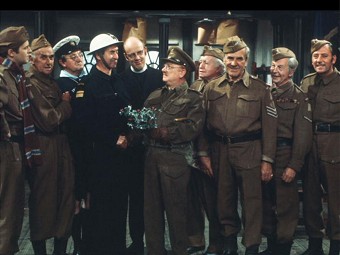
In the winter of 1968, as the smell of coal smoke clung to the air and the Beatles threatened to break up, a new type of war story was about to invade the British airwaves. But this one wasn’t about heroics or medals—no, this was a war story that dared to laugh. Dad’s Army, the brainchild of Jimmy Perry and David Croft, was about to become a classic. It gave Britain not only a chance to grin at its own past but also a window into how laughter heals a bruised national soul.
A War of Words and Wit
The Second World War had ended over twenty years earlier, yet it loomed large in the national memory. For the older generation, the war was the very soil of their identity. For the younger generation, it was history, overshadowed by the Summer of Love and the Beatles. When Perry and Croft pitched Dad’s Army, they offered something almost radical: a sitcom that turned the Home Guard—the “last line of defence” of volunteers too old or too young for active service—into comedic heroes.
At first, the idea raised eyebrows at the BBC. Who would want to watch a bunch of bumbling, washed-up soldiers in a sleepy English town? But the BBC bosses, with an admirable glint of risk-taking in their eye, understood that the idea wasn’t to mock the war, but to humanise it. They saw the spark in Perry’s memories of his days in the Home Guard and knew that under Croft’s deft hand, this could be something special.

Casting Britain’s Finest Army
Casting the show was a work of genius, blending veteran stage actors with some of the finest comic talents of the era. Arthur Lowe, fresh from Coronation Street, was an inspired choice as the pompous Captain Mainwaring. His ability to bluster with an air of desperate dignity made him the spiritual father of the platoon. John Le Mesurier brought an effortless calm as the diffident Sergeant Wilson, his laid-back upper-class style contrasting beautifully with Mainwaring’s officious bark.

Then there was Clive Dunn, decades younger than his character, as the doddering Corporal Jones; Arnold Ridley, an actor who had fought at the Somme, as sweet-natured Godfrey; and James Beck, who imbued spivvy Walker with a cheeky charm that felt both of the time and timeless. These were not just comic archetypes, but fully-formed characters, each playing a vital part in Britain’s collective memory of “the People’s War.”
Comedy in the Shadow of War
What made Dad’s Army a triumph was its ability to mine laughter from the universal truths of wartime Britain: the confusion, the bureaucracy, the endless cups of tea, and the unshakable British habit of muddling through. The show poked gentle fun at the very things that had defined a generation—ration books, gas masks, blackout curtains—without ever mocking the courage or dignity of those who lived through it.
The public’s first reactions in 1968 were a cautious chuckle, but as the episodes rolled on, the country fell head over heels in love. The Home Guard’s farcical adventures gave an affectionate portrait of how Britain saw itself: plucky, a bit chaotic, but never defeated. By the time the platoon was singing “Who do you think you are kidding, Mr. Hitler?” in living rooms from Penzance to the Highlands, Dad’s Army had secured its place in the national story.
A Toast to the BBC and the Audience
Let’s give a doff of the cap to the BBC bigwigs who gave this oddball idea a green light. They didn’t just back a show; they trusted the audience to see the beating heart behind the jokes. And the audience? Well, they saw themselves. They saw their dads, their uncles, and the quiet heroism of everyday folk. In the warmth of those chuckles, Dad’s Army became more than a sitcom—it became a reminder of Britain’s ability to find laughter in the darkest of days.
So here’s to Perry and Croft, to Mainwaring and Wilson, to Jonesy and Godfrey, and to the millions who watched. Dad’s Army was more than just a comedy; it was a national hug, a wry smile to the past, and a testament to the timeless British ability to laugh even in the face of war.


