
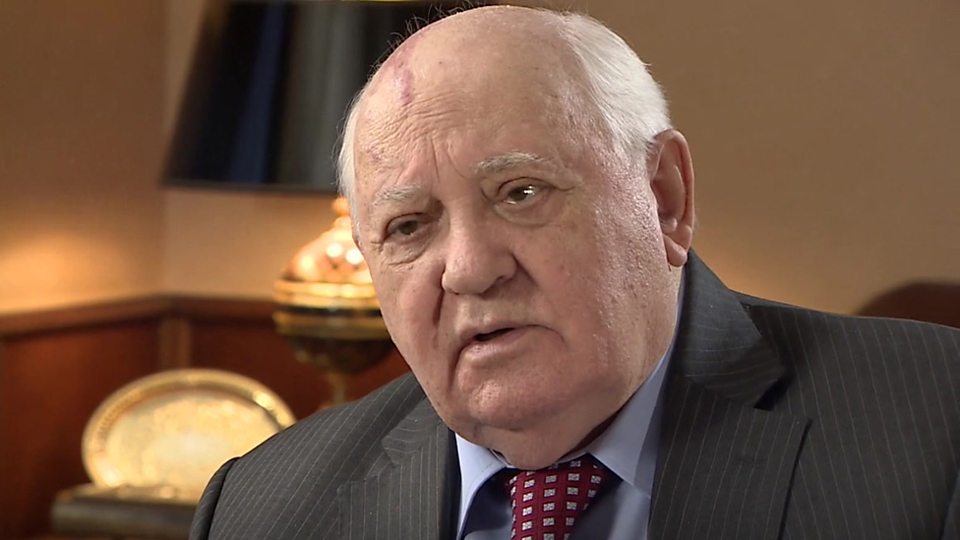
Mikhail Sergeyevich Gorbachev, the last leader of the Soviet Union died following illness in his 91st Year on 30 August 2022. His death was announced to TASS, the state news agency, by The Central Clinical Hospital on the outskirts of Moscow. It’s believed he will be buried at Moscow’s Novodevichy Cemetery alongside his wife, Raisa, who died in 1999.
He presided over the Supreme Soviet’s Presidium from 1988 to 1989, the Supreme Soviet itself from 1989 to 1990, the Communist Party of the Soviet Union’s General Secretary from 1985 to 1991, and finally the head of state of the Soviet Union from 1990 until its breakup in 1991. Gorbachev initially supported Marxism-Leninism, but by the early 1990s, he began to support social democracy.
Gorbachev was born in the impoverished peasant family of Russian and Ukrainian descent in Privolnoye, Stavropol Krai. Before joining the Communist Party, which at the time ruled the Soviet Union as a one-party state in accordance with the prevailing interpretation of Marxist-Leninist doctrine, He worked as a combine harvester operator in his youth on a collective farm while living under Joseph Stalin’s rule. He was a student at Moscow State University when he married Raisa Titarenko in 1953 and graduated from law school in 1955. He relocated to Stavropol and began working for the Komsomol youth group. After Stalin’s death, he firmly supported Nikita Khrushchev’s de-Stalinization efforts. As the First Party Secretary of the Stavropol Region Committee, he oversaw the construction of the Great Stavropol Canal.
He moved back to Moscow in 1978 to take up the position of Secretary of the party’s Central Committee. In 1979, he joined the Politburo, which governs the party. Following the brief administrations of Yuri Andropov and Konstantin Chernenko and three years after the death of Soviet leader Leonid Brezhnev, the Politburo chose Gorbachev to serve as General Secretary and de facto leader in 1985.

Gorbachev was dedicated to maintaining the Soviet Union and its socialist goals, but he also saw the need for considerable reform, notably in the wake of the Chernobyl nuclear accident in 1986. He started talks with US president Ronald Reagan to reduce nuclear weapons and end the Cold War. He also evacuated soldiers from the Soviet-Afghan War.
Indigenously, his domestic policy ‘perestroika’ (“restructuring”) initiative tried to decentralise economic decision-making in order to increase its effectiveness while his ‘glasnost’ (“openness”) policy allowed for increased press and speech freedom.


The one-party regime was damaged by his democratic reforms and the creation of the elected Congress of People’s Deputies. When some Eastern Bloc nations renounced Marxist-Leninist rule in 1989–1990, Gorbachev chose not to intervene militarily. The Soviet Union was under internal threat from rising nationalist sentiment, which prompted Marxist-Leninist hardliners to attempt the attempted August Coup against Gorbachev in 1991.
Against Gorbachev’s desires, the Soviet Union disintegrated in the wake of the coup. After leaving office, he established the Gorbachev Foundation, sharply criticised Boris Yeltsin and Vladimir Putin, and supported the social-democratic movement in Russia.
Gorbachev, who is regarded by many as one of the most important individuals of the second half of the 20th century, is still in the news. He is praised for his role in ending the Cold War, bringing new political and economic freedoms to the Soviet Union, tolerating both the fall of Marxist-Leninist governments in eastern and central Europe and the reunification of Germany. He has received a number of honours, including the Nobel Peace Prize.
On the other hand, he is frequently criticised in Russia for having helped the Soviet Union fall apart, a development that reduced Russia’s global power and sparked an economic depression in the country and its neighbouring republics.
The loss of a powerful empire that once stretched across 11 time zones, from the Berlin Wall and the Baltic Sea to the Bering Strait and Central Asia, as well as the life-altering economic and social upheaval that came along with the nation’s collapse, were largely attributed to him.
This was Gorbachev’s paradox: admired and despised for a process he started but whose outcome was predicted by only a few, probably least of all himself. The outcome has been referred to as the “biggest geopolitical tragedy” of the 20th century by Russian President Vladimir Putin, who came to power less than ten years after Gorbachev’s resignation and still holds that position today.
The degree to which Gorbachev’s revolution, which resulted in the liberation of Central and Eastern Europe from nearly 50 years of communist rule and the dissolution of the Soviet Union itself, was deliberate will likely continue to be a topic of discussion among historians. Gorbachev repeatedly emphasised that “the union might have been preserved” to demonstrate that he had no intention of overthrowing the government.
He occasionally changed his mind, but in the end he supported the forces of change that he helped to unleash. Twelve years after the Soviet Union collapsed, Gorbachev argued that those historic changes were the product of a deliberate and deeply personal decision.
Below the BBC’s Storyville highlights the man himself in a documentary called “Gorbachev. Heaven” and he discuss his role in changing the USSR/CCCP administration leading the way to the eventual collapse of the Soviet Communist state in Russia.
Mikhail Gorbachev will be best remembered like other important leaders (such as Winston Churchill, Mahatma Gandhi, Nelson Mandela, Josef Stalin, and Mao Zedong) as a man who changed the course of history; and who had a significant influence on the lives of millions of people.
Soviet President Mikhail Gorbachev about his role in reforming Russia


