
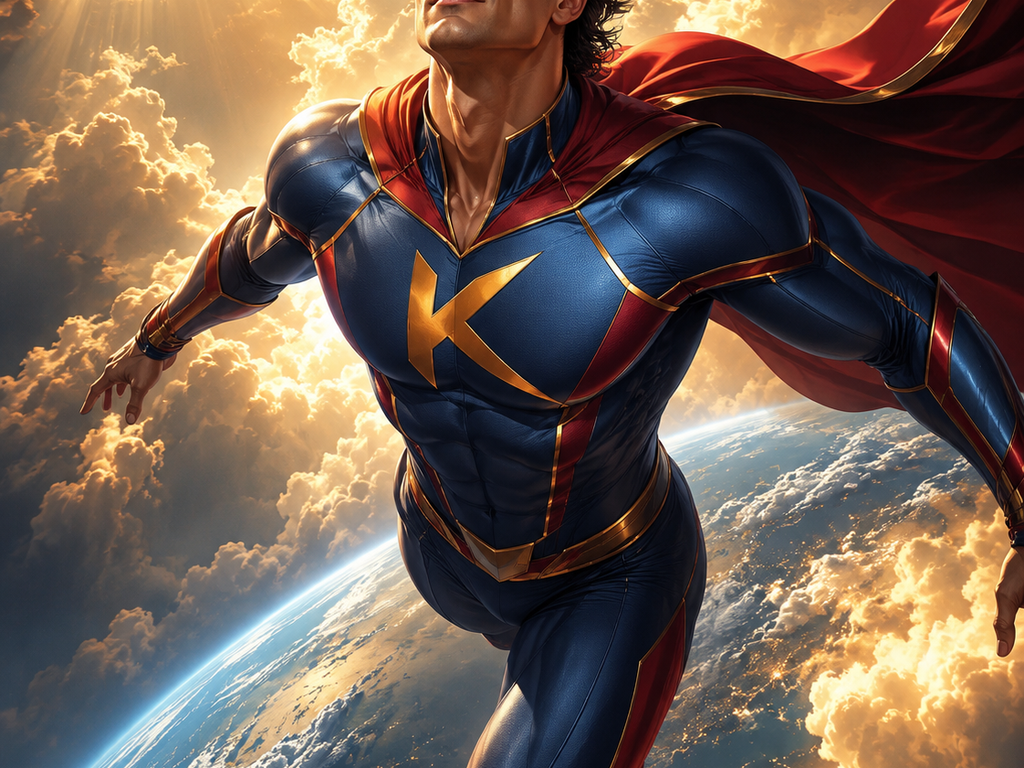
From Two Teenagers in Cleveland to an American Myth
Superman began not in Hollywood, but in the imaginations of two teenagers in Cleveland, Ohio. Writer Jerry Siegel and artist Joe Shuster met while still at school and bonded over science fiction, pulp stories and the emerging world of comic strips. During the early 1930s they began developing a character who would eventually become Superman, refining him through several different versions before arriving at the figure that made his debut in Action Comics No. 1 in 1938. The cover, showing Superman lifting a car above his head, became one of the defining images of twentieth-century popular culture. In a single stroke, Siegel and Shuster had helped create an entirely new kind of fictional hero, one who possessed extraordinary physical power yet lived among ordinary people under the identity of mild-mannered reporter Clark Kent.

The mythology quickly deepened. Superman became Kal-El, the infant son of Jor-El and Lara, sent from the doomed planet Krypton to Earth before its destruction. He was found and raised by Jonathan and Martha Kent, whose influence was crucial in shaping the man he became. Superman’s strength came from his Kryptonian origin, but his moral compass came from the human family who raised him. That combination proved to be one of the great strengths of the character. Superman was an outsider who chose humanity, an immigrant from another world who became one of Earth’s most steadfast defenders. At its heart, the story was not simply about power, but about restraint, duty and what a person chooses to do when given abilities far beyond those of everyone around him.
Radio Gives Superman a Voice
Superman escaped the comic-book page remarkably quickly. By 1940, The Adventures of Superman had begun broadcasting on American radio, bringing the character to millions who may never have bought a comic. Radio proved how adaptable Superman could be, because the hero no longer depended on pictures. Listeners were drawn into a world of Clark Kent, Lois Lane, the Daily Planet and the growing mythology of Superman through sound, narration and imagination alone. The programme also helped popularise language that became permanently associated with the character, including descriptions of Superman as faster than a speeding bullet and able to leap tall buildings in a single bound.
The radio series helped establish Superman as a genuine mass-media phenomenon rather than simply a successful comic-book character. It also demonstrated something that would remain true throughout his history: Superman could be reshaped to fit new forms of entertainment without losing the essential core of who he was. The character was becoming bigger than the medium that had created him.
The Man of Steel Reaches the Cinema
Superman next moved into cinema serials. Kirk Alyn became the first actor to portray Superman in live action in the 1948 serial Superman, followed by Atom Man vs Superman in 1950. The special effects of the period were limited, and flying scenes often relied on animation or other simple techniques, but audiences were nevertheless seeing the character physically embodied for the first time. Clark Kent could now disappear from view and return as Superman. The transformation that had existed only in drawings and listeners’ imaginations was now taking place on screen.
These early serials laid important foundations for what followed. They proved that Superman could sustain a live-action audience and helped establish visual conventions that later productions would refine. Yet it was television, rather than cinema, that would make Superman part of the everyday lives of an entire generation.
George Reeves Brings Superman Into the Home
During the 1950s, George Reeves became one of the most recognisable faces on American television through Adventures of Superman. For many viewers, particularly children, Reeves became inseparable from the role. His Superman was confident, reassuring and morally certain, while his Clark Kent retained a sense of humour and humanity. Week after week, Superman entered people’s living rooms, turning what had once been a comic-book fantasy into a familiar part of family entertainment.
The success came at a cost. Reeves became heavily associated with Superman and found it difficult to escape the role professionally. His death from a gunshot wound in 1959 was officially ruled a suicide, though debate and speculation surrounding the circumstances continued for years. Whatever the mystery that later attached itself to his death, his place in the history of the character remains secure. George Reeves proved that Superman could become a television institution, and for millions he was the definitive Man of Steel long before the era of blockbuster cinema.
Christopher Reeve and the Moment Audiences Believed a Man Could Fly
Superman underwent his greatest cinematic transformation in 1978 with Richard Donner’s Superman: The Movie. The film arrived with one of the most famous advertising promises in cinema history: “You’ll believe a man can fly.” With Christopher Reeve in the title role, Hollywood attempted something that previous productions had never been able to achieve convincingly: making Superman’s powers appear physically real on the big screen.
The production used a combination of wire rigs, optical effects, projection techniques and elaborate compositing to create flying sequences that were revolutionary for the period. Yet the film’s real success rested not simply on special effects, but on Reeve himself. He created an extraordinary distinction between Superman and Clark Kent through posture, voice, movement and confidence. Clark was hesitant, awkward and physically withdrawn, while Superman stood upright, calm and assured. The difference was so convincing that the old question of how a pair of spectacles could possibly disguise Superman suddenly seemed less absurd. Reeve made the disguise psychological as well as visual.
The supporting cast helped elevate the film further. Marlon Brando played Jor-El, Gene Hackman brought wit and flamboyance to Lex Luthor, Margot Kidder became Lois Lane, and John Williams composed a musical theme that remains almost inseparable from Superman. Reeve went on to play the role in four films between 1978 and 1987, and for a generation he became the definitive image of Superman. Even decades later, every actor who inherited the cape would inevitably be compared with him.
Christopher Reeve’s Second Life as a Campaigner
The story of Christopher Reeve took a devastating turn in May 1995 when he was thrown from a horse during an equestrian event and suffered a severe spinal-cord injury. The accident left him paralysed from the neck down and dependent on medical assistance. The contrast was cruelly stark: the actor most famous for portraying an indestructible man was suddenly confronting profound physical vulnerability.
Reeve refused to disappear from public life. Instead, he became a prominent advocate for people living with paralysis and a campaigner for spinal-cord research, disability rights and stem-cell research. He appeared before political leaders, raised funds and repeatedly argued that scientific advances could improve the lives of those living with catastrophic injuries. His campaigning gave the Superman story an unexpected real-world dimension. The fictional character had always been associated with physical strength, but Reeve’s later life demonstrated a different form of heroism based on perseverance, public service and the refusal to surrender hope.
When Christopher Reeve died in 2004, his legacy extended far beyond cinema. For many people, the actor who had once convinced the world that Superman could fly had eventually come to represent something even more powerful: courage without superpowers.
Superman Returns to the Big Screen
After Christopher Reeve’s final appearance in the role, Superman remained highly visible through television and comics, but largely disappeared from major cinema for almost two decades. That changed in 2006 when Brandon Routh took on the role in Superman Returns. The film deliberately paid tribute to the Reeve era, preserving elements of its visual style, tone and musical heritage. Routh’s performance carried traces of Reeve’s gentleness and restraint, and the production attempted to reconnect modern audiences with the cinematic Superman of an earlier generation.
Although the film developed a following, it did not produce the long-running series its creators hoped for. Superman’s next major cinematic reinvention would therefore take a very different direction.
Henry Cavill and a Darker Age of Superheroes
In 2013, British actor Henry Cavill became Superman in Zack Snyder’s Man of Steel. This was a markedly different interpretation. Cavill’s Superman existed in a world that was suspicious of extraordinary power and uncertain whether an alien with godlike abilities should be trusted. The tone was more sombre, the action more destructive and the mythology more concerned with questions of identity, fear and responsibility.
Cavill continued the role in Batman v Superman: Dawn of Justice and Justice League, presenting one of the most physically imposing versions of Superman ever seen on screen. His interpretation divided audiences. Some admired the seriousness and scale of the films, while others felt that the optimism traditionally associated with Superman had been pushed too far into the shadows. Yet the debate itself revealed something important about the character. Superman has always reflected the era in which he appears. The reassuring hero of the 1950s, the hopeful figure of 1978 and the conflicted Superman of the twenty-first century each emerged from very different cultural climates.
Television Keeps Reinventing Clark Kent
While cinema periodically struggled with Superman, television continued to reinvent him. Lois & Clark: The New Adventures of Superman in the 1990s placed much greater emphasis on the relationship between Clark Kent and Lois Lane, with Dean Cain portraying a Superman whose humanity was often as important as his powers. Smallville, beginning in 2001, approached the mythology from another direction by following a young Clark Kent before he fully became Superman. Tom Welling’s version turned the legend into a coming-of-age story about identity, friendship, responsibility and destiny.
More recently, Tyler Hoechlin portrayed Superman in Superman & Lois, where the character was presented not simply as a superhero but as a husband and father. The series explored the pressures of family life alongside the familiar threats facing the world. Once again, Superman survived by becoming more human rather than less.
David Corenswet and the Latest Generation
The latest major cinematic incarnation has placed David Corenswet in the cape, continuing a lineage that stretches back through Cavill, Routh, Reeve, Reeves and Alyn. Each actor has inherited not simply a costume but nearly ninety years of expectation. The central challenge remains surprisingly unchanged. Superman can fly, possess enormous strength and survive almost anything, yet the most compelling question has never been what he can do. It is what he chooses to do.
Superman could dominate humanity, but instead chooses to protect it. He could rule the planet, yet chooses to work as Clark Kent. He could regard ordinary people as weak, yet chooses to live among them and defend their lives as though they were his own. This tension between immense power and voluntary humility has kept the character alive across changing generations.
A Hero Who Survived Every Medium
Superman’s history is also the history of modern popular entertainment. He began in comic books, moved into newspaper strips, conquered radio, appeared in animated shorts, reached cinema serials, became a television star, transformed the modern blockbuster and later entered video games, streaming services and ever more sophisticated forms of digital entertainment. Technologies changed, actors changed, costumes changed and even the limits of Superman’s powers changed, but the central mythology endured.
That endurance is perhaps the most remarkable achievement of Jerry Siegel and Joe Shuster. Two teenagers created a character who became one of the most recognisable fictional figures on Earth. The cape, the shield, the glasses and the transformation from Clark Kent into Superman became universal symbols, understood even by people who had never opened a comic book.
Nearly ninety years later, Superman remains compelling because the fantasy is not really about invulnerability. It is about responsibility. A child arrives from another world, grows up among ordinary people and eventually discovers that almost nothing can stop him. His response is not to ask what he can take from humanity, but what he can give to it.
That is why Superman has endured.
The special effects improved. The actors changed. The world around him became darker, more complicated and more cynical.
But somewhere above Metropolis, the cape kept flying.


