
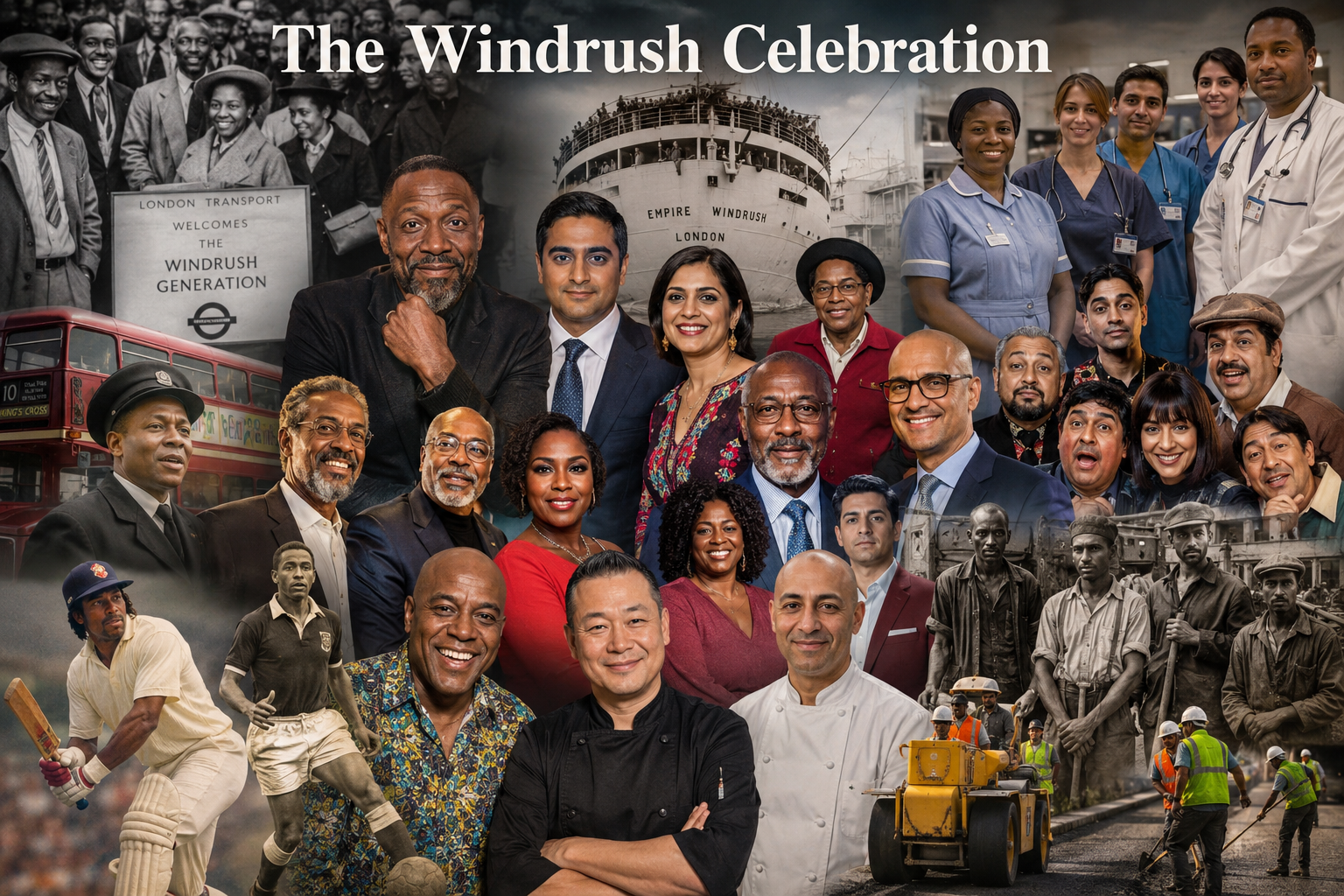
From Tilbury to the NHS, from corner shops to cabinet ministers, the story of Windrush is not a footnote to British history. It is British history.
On 22 June, Britain marks Windrush Day, a date that ought to sit far more prominently in the national calendar than it does. It commemorates the arrival in 1948 of the Empire Windrush at Tilbury, carrying hundreds of passengers from the Caribbean who had answered Britain’s call at a moment of post-war exhaustion. The country they stepped into was bruised, rationed, underbuilt and short of labour. The country they helped create in the decades that followed was richer, livelier, healthier, more talented and more honest about itself.
If modern Britain has many founding stories, Windrush is one of the most important. It is not simply a tale of immigration. It is a story about rescue, renewal and hard graft: about men and women who arrived to find a country in need of rebuilding, then did the rebuilding, often while being told they did not belong.
They staffed hospitals when the National Health Service was still young and fragile. They drove London’s buses, worked on the Underground, laid roads, cleaned trains, manned factories and took shifts others would not. They became nurses, porters, engineers, telephonists, clerks, teachers and carers. They worked nights, weekends, double shifts and Christmases. They helped hold together the public realm of post-war Britain while also trying to build lives of their own in a country that could be cold in more ways than one.

The Windrush story is often reduced to a single image: a ship docking in Essex. But the real story is far bigger. It stretches across hospital wards, transport depots, foundries, schools, police stations, cricket grounds, comedy stages, television studios, Parliament and high streets lined with family-run shops whose lights stayed on long after the supermarkets had shut.
The generation that steadied Britain
When Caribbean migrants arrived in significant numbers after the Second World War, Britain needed workers. The war had drained the country. Cities had been bombed, industries were understaffed, the transport system was short-handed and the new NHS, founded the same year as Windrush’s arrival, needed people almost immediately. Caribbean migrants answered that call.
Many found work in the health service, where Black nurses and auxiliaries became part of the NHS’s backbone. Others joined London Transport and British Rail. In the years that followed, Black Britons became a familiar part of the machinery of everyday life: the conductor on the bus, the nurse on the ward, the orderly in A&E, the man repairing the road, the woman behind the counter, the neighbour in the terraced house next door.
This contribution has sometimes been spoken of sentimentally, as if it were merely symbolic. It was not symbolic. It was material. It was practical. It was the difference between services functioning and services collapsing. Britain did not simply “welcome” Windrush migrants. Britain needed them.
And yet the welcome was often ugly. “No Blacks, No Irish, No Dogs” was not folklore but lived reality. Many Caribbean families met discrimination in housing, employment and public life. They were good enough to nurse Britain’s sick, drive Britain’s buses and clean Britain’s offices but were too often treated as strangers in the very nation they were helping to keep upright.
That contradiction lies at the heart of Windrush Day. It is not merely a day of celebration. It is also a day of memory, and memory should not be selective. The story is one of extraordinary contribution, but also of resilience in the face of insults, closed doors and casual cruelty.
From the Caribbean to the Midlands, London and beyond
The Windrush generation did not remain a London story for long. Caribbean communities took root in Birmingham, Bristol, Nottingham, Leicester, Manchester, Wolverhampton and across the industrial towns and cities of England. Churches, sound systems, cricket clubs, youth clubs, carnival traditions and community associations became part of urban British life. Food changed. Music changed. Language changed. Humour changed. Britain itself changed.
You can hear that inheritance in the cadences of Black British comedy and broadcasting. You can see it in the kitchens of television chefs and in the faces of public figures who would once have been unthinkable in British public life. You can trace it through music, fashion, literature, sport and politics. Windrush did not merely supply labour. It supplied confidence, style, rhythm, vocabulary, irreverence and a new sense of what Britain actually was.
That contribution is personified by figures such as Sir Lenny Henry, the Birmingham-born comedian, writer and actor whose parents came from Jamaica. Henry did not simply become a television star. He became one of the great popular interpreters of Black British life, carrying into the mainstream the sounds, tensions, humour and realities of post-Windrush Britain. Through comedy and drama alike, he helped Britain see communities it had too often preferred to stereotype or ignore.
Others did similar work in different forms. Television, especially from the 1980s onwards, slowly began to reflect the children and grandchildren of Windrush: not as novelties, but as Britons with stories of their own.
From the second chapter onwards: Asian Britain and the refugees who started again
But to celebrate Windrush properly is also to understand that the rebuilding of post-war Britain did not end with the Caribbean arrivals. The story widened. It deepened. It became more complicated and, in many ways, more extraordinary.
From the 1960s and 1970s onward, Britain also became home to South Asian families arriving from India, Pakistan and Bangladesh, as well as East African Asians forced out by upheaval and persecution. Some came directly from the subcontinent. Others came after lives already built elsewhere in the old empire, especially in Uganda, Kenya, Tanzania and parts of southern Africa. Many arrived with little or nothing after being expelled, dispossessed or politically cornered.
The most famous episode came in 1972, when Idi Amin ordered the expulsion of Uganda’s Asian population, giving tens of thousands of people just 90 days to leave. Families who had spent generations building businesses, schools and homes were suddenly stripped of security, property and belonging. Some came to Britain carrying little more than suitcases, documents and whatever cash they could salvage. Their story was not one of planned migration in search of opportunity. It was, in large part, a story of forced departure and survival.

Others came from countries convulsed by decolonisation and conflict, including those with links to Mozambique and other parts of East and southern Africa, where South Asian communities were uprooted by war, political upheaval or economic collapse. They arrived in Britain and began again.
And begin again they did.
For a generation of Britons, one of the most recognisable symbols of Asian migration was the family-run corner shop. It was the off-licence, still lit at 10.30pm when everything else had shut. It was the newsagent that sold milk, bread, cigarettes, batteries, aspirin and a quiet bit of human familiarity. It was the small business built on punishing hours, family labour and the determination not merely to survive but to climb.
That corner shop story is sometimes told as a cliché, but clichés exist because they contain truth. Thousands of Asian families rebuilt wealth through retail, textiles, hospitality, medicine, law, engineering and property. They put children through university; built companies; and became councillors, doctors, barristers, broadcasters and entrepreneurs. Britain’s Asian communities did not just “integrate”; they reshaped the economic and cultural life of the country.
The Britain of late-opening shops and early-morning ambition
There is something almost archetypal in that immigrant pattern: the parents who work every hour available so that their children can have choices they never had. Britain has seen it again and again. The first generation keeps the books by hand, opens before dawn, closes after dark and saves every spare pound. The second generation moves into professions, media, politics, business and the arts. By the third, the family story is woven into the fabric of national life.
It is there in the restaurateurs and grocers but also in the broadcasters, writers and comics who made Asian Britain visible to itself. Goodness Gracious Me was a breakthrough not because it politely asked for acceptance, but because it assumed its right to take the mickey out of Britain and be British while doing so. With Sanjeev Bhaskar, Meera Syal, Kulvinder Ghir and Nina Wadia, it took the experience of British Asians and made it not an exotic sidebar but a source of mainstream comedy. Later, The Kumars at No. 42 turned the Asian family home into one of the most inventive comic settings on television, with Bhaskar once again at the centre of it.
That mattered. It mattered because representation is not a modern slogan dreamt up in a seminar room. It is about whether a country sees its own citizens clearly enough to recognise them as part of the national story. Goodness Gracious Me and The Kumars did exactly that. They made Britain laugh, but they also made Britain look in the mirror.
Breaking barriers in uniform
The same long struggle for visibility and acceptance played out in public service.
In 1967, Norwell Roberts became the first Black officer to join the Metropolitan Police in modern times, enduring appalling racism while forcing open a door that had effectively been closed. A year later, Sislin Fay Allen became Britain’s first Black female police constable. A Jamaican-born nurse before joining the Met, Allen’s career carried immense symbolic weight. These were not simply personal achievements. They were acts of institutional breach. They announced, in uniform, that British authority could no longer be imagined as white by default.

Their presence in the police mattered not only because they were pioneers but also because they exposed the contradiction at the heart of post-war Britain. A country that relied on migrant labour still struggled to accept migrant authority. Roberts and Allen helped break that pattern. Later generations of Black and Asian officers would follow, but it is worth remembering how lonely the first steps were.
Politics catches up eventually.

Politics was slower still, but it changed.
Black Britons who had spent decades helping to build the country eventually began to enter Parliament in numbers that forced Westminster to acknowledge a Britain beyond its old assumptions. Diane Abbott, Bernie Grant, Keith Vaz and Paul Boateng were among the landmark figures of that change. Boateng, later Lord Boateng, would go on to become the first Black Cabinet minister, a milestone that would once have seemed unimaginable in the House of Commons of the old empire and old certainties.
Their arrival did not solve Britain’s racial problems, nor did it end the harder argument about class, immigration and national identity. But it changed the shape of British democracy. It meant that children of migrant families could look at the green benches and see something other than exclusion.

Sport, the oldest theatre of belonging
Sport, too, tells the story of Black Britain long before politics caught up. Arthur Wharton, born in what is now Ghana, is widely recognised as the world’s first Black professional footballer. Walter Tull, who played for Tottenham Hotspur and Northampton Town before serving in the First World War, remains one of the most remarkable and moving figures in British sporting history: a gifted footballer, an officer, and a man who navigated a deeply racialised Britain with extraordinary dignity.

In cricket, the great Learie Constantine stands out as both a sporting titan and a political figure, a West Indian cricketer of brilliance who later became a lawyer, diplomat and peer. His life, like so many of these lives, crossed boundaries between empire and nation, between sport and public service, between prejudice and achievement.
From there, the line runs straight to the present: to generations of Black and Asian footballers, cricketers, sprinters and Olympians who have worn England shirts, represented Britain and transformed the national imagination of who gets to be at the centre of the picture.
The kitchen table, the television studio and the ward round
The story of immigrant Britain is also told in softer, warmer ways: at the kitchen table, in the cookbook, on children’s television, on Saturday-night light entertainment and in the consulting room.
Ainsley Harriott and Rustie Lee brought Caribbean warmth, flavour and personality into British homes through television food culture, turning cuisine into a kind of national conversation. Ken Hom, though not British-born, helped widen British tastes and understanding of Asian food at a time when many households still treated “foreign food” as an event rather than an everyday pleasure. Meanwhile, doctors, nurses, pharmacists and academics from across the Commonwealth and beyond were changing British life in ways less glamorous than television but far more profound.
There is scarcely a British family untouched by that contribution. If you have ever been treated in an NHS hospital, collected a prescription from a local chemist, been taught by a teacher whose parents arrived from Kingston, Kampala or Karachi, caught a bus driven by the son of migrants, or bought milk from a shop open late because its owners worked fourteen-hour days, then you have lived inside this story whether you realised it or not.
England, and Britain, remade from within
There is a habit in some corners of British politics to talk about immigration as though it is a modern inconvenience imposed on a settled nation from outside. Windrush Day is a useful antidote to that nonsense. It reminds us that modern England was not passively “changed” by immigrants. It was actively built with them.
The NHS was not saved in the abstract. It was saved by people in uniforms, on wards, on buses, in boiler rooms, behind counters and in staff canteens. Roads were not repaired by speeches. They were repaired by labour. Public transport did not run on nostalgia. It ran on workers. And many of those workers came from the Caribbean, from South Asia and from East Africa, carrying British passports, Commonwealth identities, family hopes and, very often, a great deal more courage than the country they arrived in deserved.
Windrush Day should therefore be more than a ceremony of official gratitude. It should be a day for historical honesty. Britain owes a debt not only to the Caribbean men and women who came after the war but also to the Asian families who rebuilt their lives here after expulsion and upheaval; to the pioneers who entered the police; to the pioneers who entered Parliament; to the pioneers who entered sport; and to the pioneers who simply kept a small business going so their children might inherit something better.
The miracle of post-war immigration to Britain is not that it happened. It is that so many people arrived to indifference or hostility and still chose to invest their energy, talent and loyalty in this country anyway.
They built wards and bus routes. They built businesses and neighbourhoods. They built stages and television studios. They built lives. They built wealth. They built institutions. They built futures for children who would one day become comedians, cabinet ministers, judges, doctors, footballers, teachers and authors.
They built Britain and England too.
Windrush Day should say so plainly. Not as a slogan. Not as an act of fashionable piety. But as a matter of fact.


