
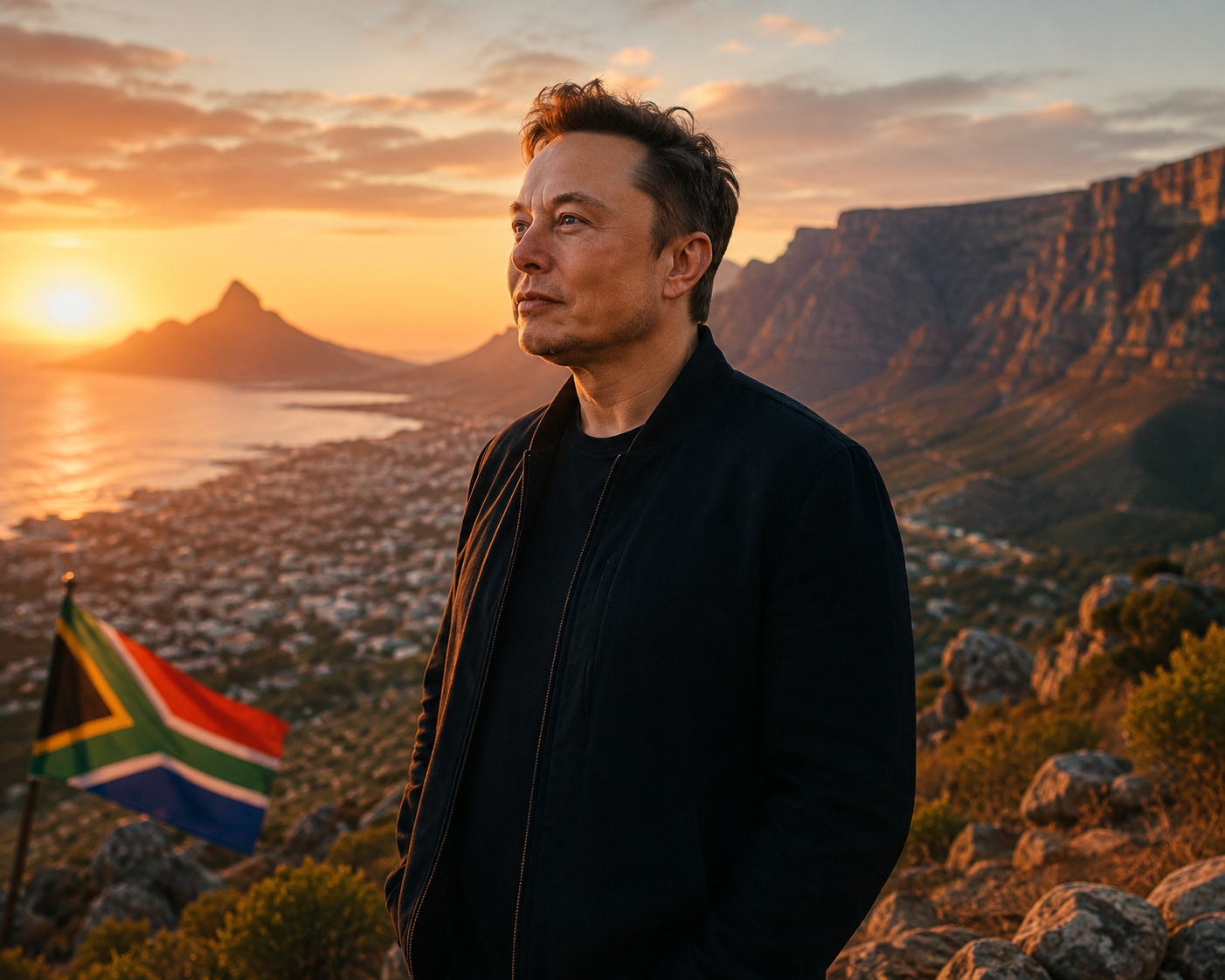
The history of southern Africa is a story of extraordinary wealth, bitter conflict, political transformation and remarkable human resilience. It is a land whose fortunes have been shaped by gold, diamonds, empire and revolution. Over the course of little more than a century, it has produced empire-builders, freedom fighters, industrialists and innovators whose influence has reached far beyond the continent itself. Among the most famous of these modern figures is Elon Musk, the South African-born entrepreneur whose ambitions now stretch from artificial intelligence and robotics to electric vehicles and interplanetary travel.
To understand Musk’s place in the modern world, it is worth looking back at the turbulent history of the country that helped shape him.
The modern story of southern Africa cannot be told without reference to Cecil Rhodes, one of the most influential and controversial figures of the British Empire. Arriving in southern Africa during the great diamond rush of the nineteenth century, Rhodes amassed an immense fortune through mining interests and the company that would become De Beers. His wealth brought him political influence, and his political influence brought him power on a scale few businessmen have ever enjoyed.
Rhodes dreamed of expanding British control across the African continent and was instrumental in extending imperial influence northwards. Territories that later became Zimbabwe and Zambia once bore his name as Rhodesia, a lasting reminder of the era in which European powers carved up vast regions of Africa in pursuit of resources and strategic advantage. To admirers, Rhodes represented ambition and enterprise. To critics, he embodied colonial exploitation and the extraction of wealth from lands whose people often saw little benefit from the riches taken from beneath their feet.
The legacies of empire would continue to shape South Africa long after Rhodes himself had passed into history. Throughout much of the twentieth century, the country became increasingly defined by apartheid, the system of racial segregation that formalised inequalities between white and non-white South Africans. Under apartheid, political rights, economic opportunities and social freedoms were distributed along racial lines, creating divisions that would leave deep and lasting scars upon the nation.
It was during this period that Nelson Mandela emerged as one of the leading figures of resistance. Arrested in 1962 and later sentenced to life imprisonment, Mandela would spend twenty-seven years behind bars while becoming a global symbol of the struggle against apartheid. His release in February 1990 marked one of the defining moments of the twentieth century. Television viewers around the world watched as he walked free from prison, carrying with him the hopes of millions who believed South Africa stood on the threshold of a new era.
The years that followed brought both optimism and uncertainty. The dismantling of apartheid and the country’s first democratic elections in 1994 represented a historic achievement, but the transition was neither simple nor painless. South Africa faced enormous challenges, including economic inequality, social tensions, violent crime and the difficult task of building a society capable of moving beyond decades of institutional division. For many Black South Africans, the new era represented long-overdue justice and opportunity. For many white South Africans, it was a period of profound adjustment as old certainties disappeared and a new political reality emerged.
It was against this backdrop that Elon Musk spent his formative years.
Born in Pretoria in 1971, Musk grew up during the final decades of white minority rule. His mother, Maye Musk, worked as a model and dietitian, while his father, Errol Musk, was an engineer and businessman involved in a variety of commercial ventures. Like many white South African families of the period, the Musks enjoyed advantages that came with their social and economic position, even as the country around them wrestled with growing political tensions and international isolation.
Accounts of Musk’s childhood often describe him as introspective, highly intelligent and deeply immersed in books. He reportedly devoured science fiction novels, technical manuals and encyclopaedias with equal enthusiasm. While many children sought adventure on sports fields or playgrounds, Musk’s adventures frequently took place in his imagination. The worlds he explored through literature would later influence the extraordinary ambitions that came to define his adult life.
South Africa in the 1980s was becoming an increasingly unsettled place. International sanctions, political unrest and growing pressure for reform created an atmosphere of uncertainty. Like many young South Africans looking for opportunities beyond the country’s borders, Musk began to look abroad. At the age of seventeen he moved to Canada, taking advantage of his mother’s Canadian heritage before eventually settling in the United States. Although South Africa would remain part of his identity, he would never again live there permanently.
The move proved to be the first step in one of the most remarkable entrepreneurial journeys of the modern age.
After studying and pursuing opportunities in North America, Musk became involved in the emerging internet economy of the 1990s. He co-founded X.com, an online financial services company that would eventually merge with Confinity and evolve into PayPal. The sale of PayPal generated the capital that allowed Musk to pursue projects that many observers considered impossibly ambitious.
Rather than investing his fortune conservatively, Musk placed enormous sums into ventures that appeared highly risky. SpaceX sought to challenge the traditional economics of space exploration. Tesla attempted to popularise electric vehicles at a time when most major manufacturers remained sceptical about their commercial viability. Both companies experienced periods in which failure appeared entirely possible, yet both survived and eventually transformed their respective industries.
Over the following decades Musk expanded his interests into fields ranging from renewable energy and satellite communications to artificial intelligence, robotics and neurotechnology. Through ventures such as Neuralink, xAI and The Boring Company, he cultivated a reputation as a businessman willing to pursue ideas that others dismissed as unrealistic. His supporters argue that this willingness to challenge conventional wisdom is precisely what has enabled him to achieve what many considered impossible. Critics contend that his confidence sometimes spills into recklessness and overstatement.
Whatever view one takes, it is difficult to deny the scale of his influence. Few individuals have played such a prominent role in shaping debates about the future of transportation, energy, artificial intelligence and space exploration.
Yet Musk’s public image extends far beyond business and technology. In recent years he has become an increasingly vocal participant in political and cultural debates, particularly through his ownership of the social media platform X. His comments on free speech, government regulation, immigration, identity politics and international affairs have attracted both admiration and criticism in equal measure. To supporters, he represents a willingness to challenge prevailing orthodoxies and question established institutions. To detractors, he often appears provocative, divisive and dismissive of legitimate concerns.
The result is a public figure who inspires unusually strong reactions. Some regard him as one of the great innovators of the modern era, a visionary determined to push humanity towards a more technologically advanced future. Others see him as a symbol of the growing concentration of wealth and influence in the hands of unelected billionaires. The debate surrounding Musk often says as much about contemporary society as it does about the man himself.
What remains beyond dispute is that Musk’s story cannot be entirely separated from the history of South Africa. Although his achievements were realised elsewhere, the country of his birth formed the backdrop to his earliest experiences and helped shape the environment from which he emerged. South Africa’s history of empire, conflict, transformation and reinvention is echoed, in different ways, within Musk’s own journey from Pretoria schoolboy to the wealthiest individual on Earth.
Perhaps that is why Enya’s haunting song Storms in Africa feels such an appropriate accompaniment to this story. Its sweeping melodies evoke a continent that has witnessed extraordinary triumphs and tragedies, a place where history often unfolds on a grand scale. The storms that once centred upon diamonds, gold and political power have not disappeared. Instead, they have evolved into new contests over technology, information, artificial intelligence and the future direction of human civilisation.
From the age of Cecil Rhodes to the age of Elon Musk, southern Africa continues to cast a long shadow across the world. The characters have changed, the industries have changed, and the technologies have changed, but the themes of ambition, power, wealth and iSouthern remain as relevant as ever. Elon Musk may now speak of Mars, autonomous robots and artificial intelligence, yet his story still begins in a nation whose own history was shaped by some of the greatest storms of the modern age.


