
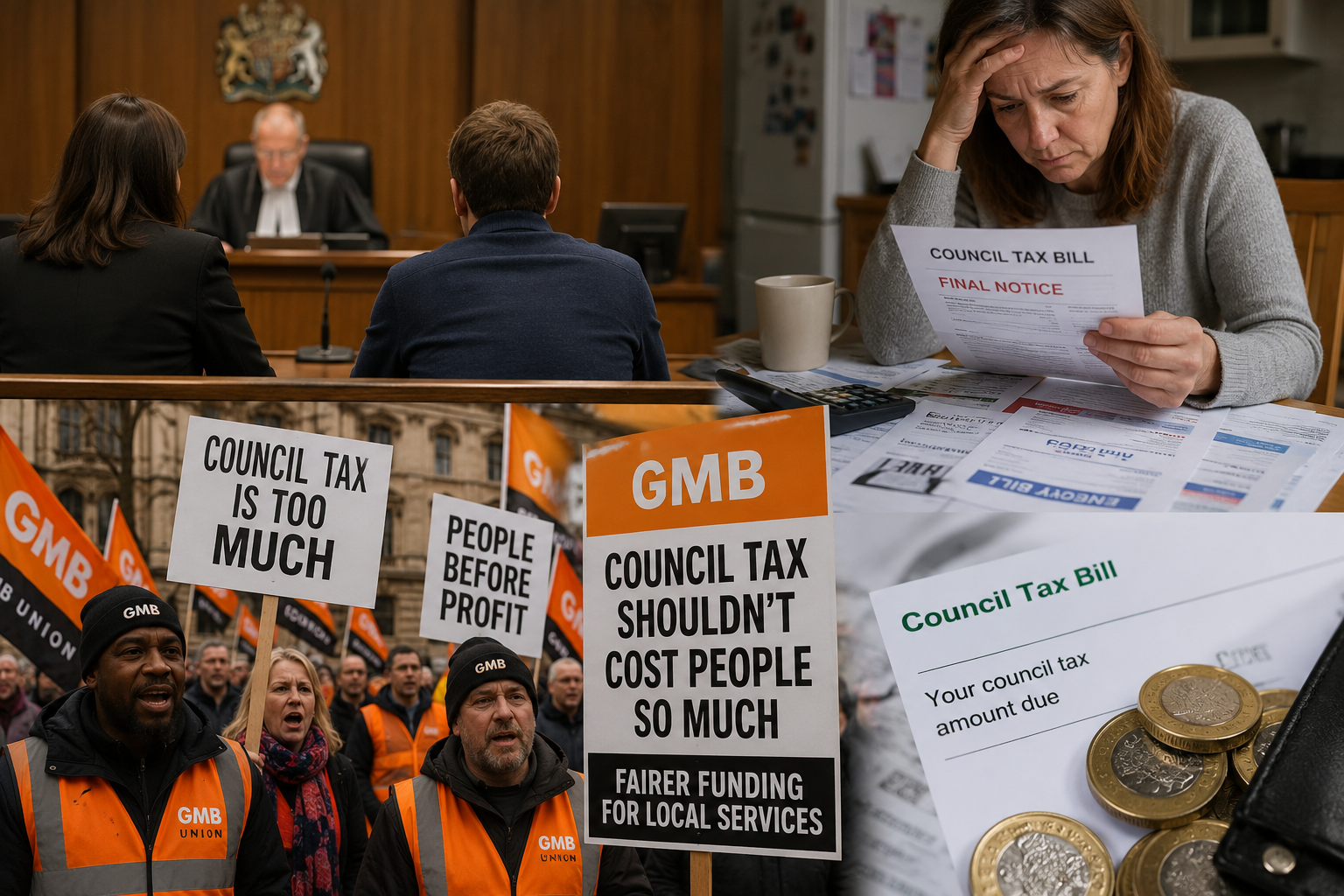
Millions Struggling as Council Tax Debt Crisis Pushes 1.5 Million People Towards the Courts
More than 1.5 million people were dragged into court proceedings over unpaid council tax during the last financial year, according to a major investigation that has highlighted the growing financial pressures facing households across the United Kingdom.
Research conducted by the GMB union, based on Freedom of Information requests sent to around 200 local authorities, paints a troubling picture of families struggling to keep up with rising bills while councils battle mounting budget pressures of their own.
The investigation found that local authorities issued at least 1.4 million court summonses during the 2024/25 financial year. However, the true figure could be significantly higher, as not every council responded to the union’s enquiries.
At the same time, unpaid council tax debts have reached an estimated £4.6 billion, with more than 4.5 million accounts currently in arrears. Of those, around 3.2 million are understood to be subject to active debt recovery or management procedures.
The findings suggest that millions of households are finding it increasingly difficult to meet one of the most unavoidable household expenses, as the continuing cost-of-living pressures squeeze already stretched budgets.
The scale of the problem varies across the country. Scotland reportedly has the highest overall level of council tax debt, while Wales records the lowest levels of arrears.
Speaking at the union’s annual congress in Blackpool, GMB representatives described the current council tax system as no longer fit for purpose, arguing that both residents and local authorities are trapped within a framework that is failing to meet modern economic realities.
The union says several factors are contributing to the crisis. Rising food prices, energy costs, housing expenses and wider inflationary pressures have left many families struggling to cover essential bills. At the same time, campaigners argue that the council tax banding system, much of which is still based on property valuations dating back decades, places an unfair burden on many lower and middle-income households.
Local authorities themselves are also facing increasing financial strain. After years of funding reductions and growing demand for public services, councils have become increasingly reliant on council tax revenues to maintain everything from social care and waste collection to local infrastructure and community services.
As a result, many councils have little choice but to pursue unpaid debts through legal channels, even when residents are already facing significant financial hardship.
The GMB is now calling on central government to undertake a wider review of local government finance. Among its proposals are increased funding for councils, reforms to council tax property bands to ensure wealthier households contribute more, and changes to business rates aimed at supporting local economies and revitalising town centres.
The findings are likely to intensify the debate over how local services should be funded in the years ahead, particularly as both councils and households continue to grapple with the financial aftershocks of a prolonged cost-of-living crisis.
For many families, the figures tell a stark story: millions are falling behind, billions remain unpaid, and an increasing number are finding themselves facing the courts simply because they cannot afford to keep up.
I quite like that closing line. It leaves the reader with the human reality behind the statistics rather than just another column of numbers.


