
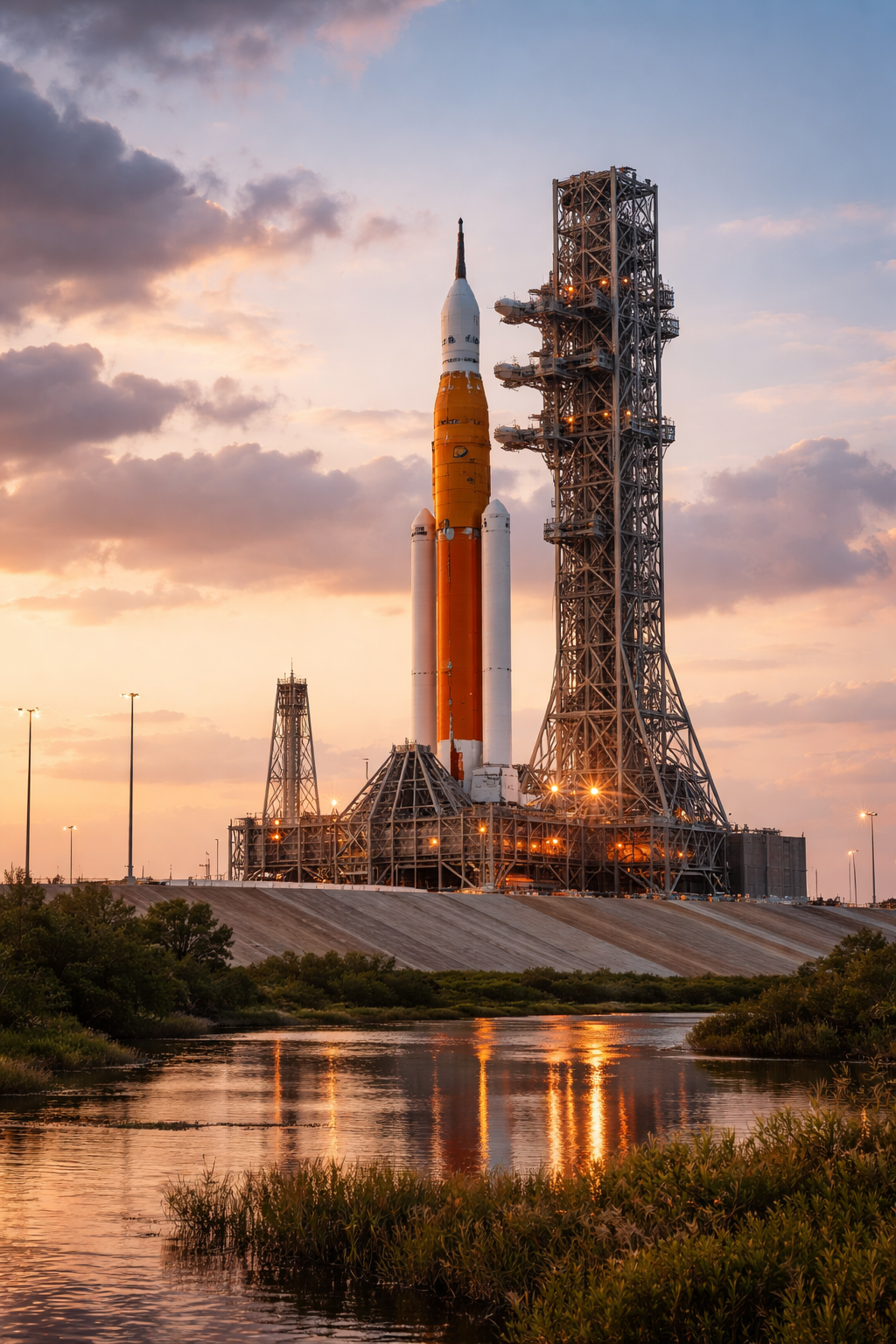
The evening sky over Florida is poised to become a stage for history as NASA prepares to launch its Artemis rocket from Kennedy Space Centre in just over an hour.
Anticipation is building along the Space Coast and far beyond, as this mission represents another bold step in humanity’s return to the Moon.
The Artemis programme, named after the twin sister of Apollo in Greek mythology, is designed to carry astronauts back to the lunar surface for the first time in more than half a century. Unlike the Apollo era, however, this new chapter aims to establish a sustained human presence, laying the groundwork for future missions deeper into space, including Mars.

NASA/Bill Ingelis
At the heart of the mission is NASA’s powerful Space Launch System (SLS), the most advanced rocket ever developed by the agency. Towering over the launch pad, the SLS is capable of producing more thrust than the Saturn V rockets that powered the Apollo missions. Sitting atop it is the Orion spacecraft, which will carry astronauts on future crewed flights and, in this mission, will undertake a critical test journey around the Moon.
Tonight’s launch is a crucial milestone. Depending on the specific mission profile, Artemis flights are designed either to test systems in deep space or to carry crew members on increasingly complex missions. Each step builds towards the ultimate goal of landing astronauts, including the first woman and the first person of colour, on the lunar surface later this decade.
Weather conditions and final technical checks remain key factors in the countdown. NASA engineers have spent months analysing every component of the rocket and spacecraft, aiming to minimise risk in what is an extraordinarily complex operation. Even so, spaceflight remains inherently unpredictable, and launch windows are carefully calculated to ensure the best possible conditions.
Crowds have gathered across Florida’s coastline, while millions more are expected to watch the event live around the world. For many, the Artemis programme represents more than a scientific endeavour. It is a symbol of renewed ambition, international collaboration, and the enduring human desire to explore beyond our home planet.
If successful, tonight’s 6pm (approximately 11pm GMT) launch will not only mark another technical achievement for NASA but also signal that humanity is once again reaching for the Moon—this time with its sights set even further into the cosmos.


