
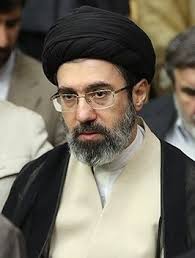
New leader is he someone new? Can he deal with American and Israel Stikes as Donald Trump demands their submission!
In this war any country could be hit even UAE.
Ayatollah Ali Khamenei was reportedly killed in joint U.S.-Israeli strikes amid an escalating conflict. In the days that followed, the Assembly of Experts—an 88-member body of clerics tasked with selecting and supervising the Supreme Leader—convened under extraordinary pressure, including from the Revolutionary Guards, wartime chaos, and even threats of further targeting of potential successors.
Mojtaba Khamenei is a Shia cleric and the son of Iran’s long-time Supreme Leader, Ayatollah Ali Khamenei. For many years he remained a relatively shadowy figure in Iranian politics, rarely giving speeches or appearing in public roles. Instead, he was widely believed to work behind the scenes within his father’s office and among powerful conservative networks in the Iranian state.

Born in 1969 in Mashhad, Mojtaba grew up inside the political world created after the 1979 Iranian Revolution. He studied Islamic theology in the religious seminaries of Qom, the main centre of Shia scholarship in Iran.

During the later stages of the Iran-Iraq War he reportedly volunteered with Iranian forces, something that helped build his credibility among hard-line revolutionary circles.
Over time he developed strong relationships with influential clerics and with members of the Islamic Revolutionary Guard Corps, one of the most powerful institutions in the country. Because of these connections, many analysts believed he had accumulated quiet influence inside the Iranian power structure long before his rise to the top leadership position.
His emergence as Supreme Leader is controversial for several reasons. The Islamic Republic was founded partly on opposition to hereditary rule, so the idea of power passing from father to son is uncomfortable for many Iranians. Critics argue that it makes the system resemble a political dynasty rather than a revolutionary republic.
Supporters within the ruling establishment, however, see him as someone capable of maintaining stability and protecting the ideological foundations of the state.
Inside Iran the reaction to his leadership is mixed. Among conservative political and religious circles there is support for continuity and for someone seen as loyal to the revolutionary system. Within the security establishment, particularly the Revolutionary Guards, he is often viewed as a trusted figure who understands the structure of power.
Among many ordinary citizens, however, the mood is more uncertain or skeptical. Some people fear his leadership represents a continuation of strict policies and limited political reform.
Younger Iranians in particular have shown frustration in recent years over economic problems, social restrictions, and political repression, and those tensions have not disappeared with the leadership change.
Mojtaba Khamenei’s personality is often described by observers as quiet, cautious and highly strategic.
Unlike many politicians, he has never cultivated a strong public image or populist following. Instead, his influence grew through networks of loyalty within the religious and security institutions that dominate Iranian politics.
Taking leadership of Iran places him at the centre of a complicated situation. The country faces economic pressure from sanctions, political divisions at home, and ongoing tensions with Western countries and regional rivals.
These challenges mean that his leadership will likely be judged not only by ideological supporters but also by a population that has grown increasingly restless over the past decade.
For supporters he represents stability and continuity of the Islamic Republic’s revolutionary system. For critics he symbolizes the concentration of power within a narrow ruling elite.
His rule therefore begins under a cloud of uncertainty about whether Iran will continue along its current path or eventually move toward change.


