
Universal’s new resort near Bedford is set to open in 2031, attracting 8.5 million visitors annually.
However, a similar vision was announced just outside Corby, Northamptonshire, called WonderWorld, which was an ambitious £346m project designed by Monty Python’s Terry Gilliam.

The park was planned to be built on a 1,000-acre site at Priors Hall, about two miles (3km) north-east of Corby. The land, part of a disused quarry once linked to the town’s former steelworks, was identified as the ideal location due to strong local support.
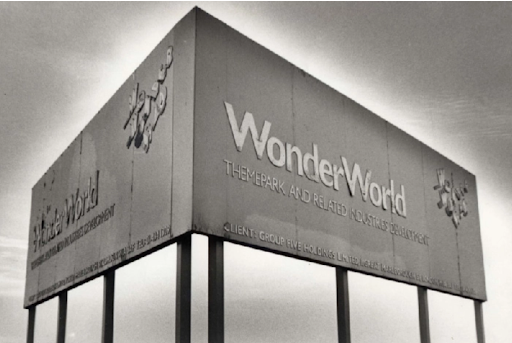
Signs for the theme park feature in Netflix’s Toxic Town and it is mentioned in BBC podcast The Toxic Waste Scandal.
Developers Group Five described the area as the perfect home for the park, citing the “positive attitude displayed by the local and county authorities and the Commission for the New Towns”.

The attraction was described as the “equivalent of America’s Disneyland” and was supposed to be an answer to unemployment in Corby following the 1980 closure of the steelworks, which led to 10,000 job losses and left nearly a third of the town out of work.
WonderWorld was intended to offer a unique resort set in beautifully landscaped surroundings with an “accent very much on participation.” The park’s overall goal was to launch a new leisure industry built around “British heritage, folklore, science, and innovation”.
WonderWorld, the dream of a popular theme park in Corby, was planned to include a mock safari, a 10,000-seat indoor sports stadium, a concert arena, and a family resort with hotels.
The 39-month construction programme was expected to open by 1992, with plans to welcome four million visitors a year and provide employment.
However, the park would have brought employment to those unemployed in Corby following the 1980 steelworks closure.
The park’s blueprint was inspired by Disney’s Epcot Park in Orlando, featuring a large Spaceship Earth ride inside a spherical golf-ball-like structure. The park also featured a themed village around a central bowl, 700m in diameter.
Architect Derek Walker, in 1985, praised WonderWorld for its high-level entertainment, participatory nature, and educational aspects.
The first phase of construction was estimated to cost £223m, with the full development forecast to hit £346m.

The 39-month construction timeline was set, aiming for an initial opening in 1985.
Despite early enthusiasm, WonderWorld’s momentum began to stall due to rising costs, planning delays, and difficulty securing long-term funding. Backers pulled out, and as public investment wavered, the vision began to fade.
All that was ever erected at the site was a large WonderWorld sign and a small wooden cabin. The land is now home to more than 1,000 houses at Priors Hall Park, and there are plans to build just more than another 5,000 houses.


One thought on “CORBY’S ‘DISNEYWORLD’ THAT NEVER HAPPENED”
Comments are closed.