
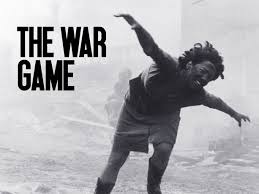
The picture didn’t open to the public until its premiere on April 13, 1966, and it lasted until May 3, 1966, at London’s National Picture Theatre. After that, it went on to win the Special Prize at the Venice Film Festival and several other international screenings. The film was also named 1967’s Best Documentary Feature at the Oscars.
On July 31, 1985, one day before a rerun of Threads, the film finally made its way to British television, airing just one week before the Hiroshima bombing’s forty-first anniversary.
A summary of the Film:
Beginning with the destruction wreaked by the British V bomber squadron’s Victor and Vulcan Mk II nuclear bombers, the narrator describes Britain’s nuclear deterrence posture. These would be spread out around the nation in the event of an emergency, and in the event of a conflict, they would be targeted by thermonuclear attacks alongside the already heavy bombardment of key cities.
The UK declares a state of emergency on Friday, 16 September. The United States has sanctioned the use of tactical nuclear weapons by Chinese forces in South Vietnam, which the Chinese have invaded. Without a U.S. reversal, the Soviets and East Germans would invade West Berlin. Emergency committees made up of city and borough politicians are responding to a harrowing mass evacuation of women, children, and the sick in the southeast county of Kent.

Under the fear of incarceration, homeowners are compelled to billet and feed the arrivals, while unoccupied residences are requisitioned. People are given ration cards.
Civil defence distributed a leaflet the next day that had been available for a while but had not sold well; the booklet detailed the perils of nuclear war. After testing the emergency siren system, it is anticipated that there will be approximately 2.5-3 minutes till impact, or less than 30 seconds in the event of an assault by a submarine if the system could be informed of an attack.
Many people can’t afford the construction supplies in high demand because of the outrageous prices.
The invasion occurs because the United States refuses to give in to communist demands. Berlin is besieged by Russian and East German forces, despite the best efforts of two U.S. Army divisions.

The leaders of NATO quickly fire Honest John rockets after receiving authorization from President Lyndon B. Johnson to employ tactical nuclear weapons. According to the video, a large number of Soviet strategic IRBMs are thought to be stored above ground and powered by liquid, which leaves them highly susceptible to attack. The Soviet Union, according to this theory, would have to shoot them all down early in a nuclear confrontation if it wanted to keep them from going down.
A family in Canterbury, Kent, receives a house call from a doctor who is now part of an emergency medical aid unit on September 18th. Two members of the civil defence team accompany the doctor. The distant sound of air-raid sirens begins to blare around 9:13 in the morning, and then a police car’s klaxon horn follows. In a last-ditch effort to find refuge, relatives and guests scramble to relocate furnishings.
The Soviet Union launches a one-megaton thermonuclear weapon at 9:16 a.m., with the target being Manston Airfield 12 miles distant; six miles away, the warhead bursts. As a defence worker brings a young boy in from the yard, they are both blinded by the distant heat wave, which causes third-degree burns and the “melting of the upturned eyeball.” The occupants inside rush to extinguish the raging fires that have broken out on various pieces of furniture before the shock front arrives.
Two bishops are briefly quoted in the film as saying that believers should “learn to live with, though need not love, the nuclear bomb.” The camera pans back to a 27-mile-away scene of a young child with serious retinal burns as a result of a bomb. The blast waves shake their house, and his father takes him into hiding behind a table. Then, another one comes from Gatwick Airport in Sussex, which is 41 miles distant. A missile burst off-course en route to London Airport, causing Rochester to burn.

The firestorm’s winds, which reached over 100 mph, caused serious casualties among firefighters. Both firefighters and bystanders succumb to heat exhaustion and the gases released when the firestorm’s core temperature reaches 800 °C and begins to refuel with methane, carbon monoxide, and carbon dioxide. Near the Russian border, British V bombers inflict the same on the Russian people by 10:47 in the morning.
Medical services are overwhelmed in the aftermath. As patients are prioritised, the narrator states that every remaining doctor would encounter a minimum of 300 casualties. The worst wounded are transferred to an adjacent room and left to suffer in silence until they die. The victims are triaged, and some of them are shot by armed cops. There is a significant loss of personnel in the police force, civil defence, and British Army due to the prevalence of PTSD and other illnesses. Authorities in “lightly hit” Kent burn corpses in abandoned houses because there are too many casualties to bury.
Dresden is known for its habit of collecting wedding bands from the deceased in buckets for the sake of future identification. According to one account, her family has no choice but to use the water from their bathtub for everything from drinking and cooking to taking baths.
According to what the video says happened in Nagasaki and Hiroshima, a lot of people became “apathetic and profoundly lethargic, people living often in their own filth.”
The authorities in Kent eventually limit food distribution to just law enforcers, arming the remaining police, as food supplies decrease. Disputes about food scarcity escalate into violent clashes. A couple of days down the road, dissidents hijack an armoured police vehicle and brutally plunder a government food inspection facility.

As the credits roll, the song “Silent Night” begins to play.
There are casualties among the police and the soldiers. Two men, including the father who had rescued his blinded child earlier, are shot by firing squad for civil disturbance and obstruction of government officers, which are now capital offences.
The first symptoms of scurvy appeared. The film comes to a close on Christmas Day, the first after the war, in a Dover refugee complex.
The film depicts a number of war victims, including a pregnant girl who is very unlikely to have a healthy baby and a boy who the narrator says will be bedridden for seven years before dying from radiation.
The question of what they aspire to become as adults is met with blank stares or the phrase “don’t want to be nothing” from confused and traumatised forgotten kids. As nuclear weapons stockpiles continue to expand, the narrator laments the lack of coverage in the modern press about the risks of nuclear war.


