
⚒️ The First Strike—Iran, 1908
In 1908, British geologist George Bernard Reynolds struck oil in Masjed Soleiman, Iran. This discovery led to the formation of the Anglo-Persian Oil Company—the ancestor of BP. For the British Empire, this wasn’t just crude—it was liquid empire.
💣 The Suez Gamble—Egypt, 1956
In a fiery act of defiance, Egyptian President Gamal Abdel Nasser nationalized the Suez Canal. It was a power play—removing British and French control from a vital artery of oil transport. The Suez Crisis ensued, but it marked the twilight of old colonial rule in the region.
- Iran: Oil discovered in 1908, leading to large-scale production by the 1920s.
- Bahrain: First oil well (Bahrain No. 1) drilled in 1932.
- Saudi Arabia: Commercial oil discovered at Dammam No. 7 in 1938.
- Kuwait: Oil discovered in 1938 in the Burgan field, after drilling began in 1936.
- Iraq: Oil discovered in 1927, with production starting in 1934.
- Syria: Oil exploration began in 1933, and significant production started in 1968.
- United Arab Emirates: Oil discovered in 1959, with exports starting around 1962.
🛢️ The OPEC Era
OPEC was born in 1960 to give oil-producing nations control over their resources and prices. Led initially by the likes of Saudi Arabia, Iraq, Iran, and Venezuela, OPEC flexed its muscle in 1973 with an embargo that caused fuel shortages and economic shockwaves across the West.
OPEC, the Organization of the Petroleum Exporting Countries, was founded on September 14, 1960, in Baghdad. The founding members were Iran, Iraq, Kuwait, Saudi Arabia, and Venezuela. Their goal was to coordinate and unify petroleum policies among the member countries to ensure fair and stable prices for oil producers.
🔥 Saddam Hussein and the Gulf Invasion – 1990
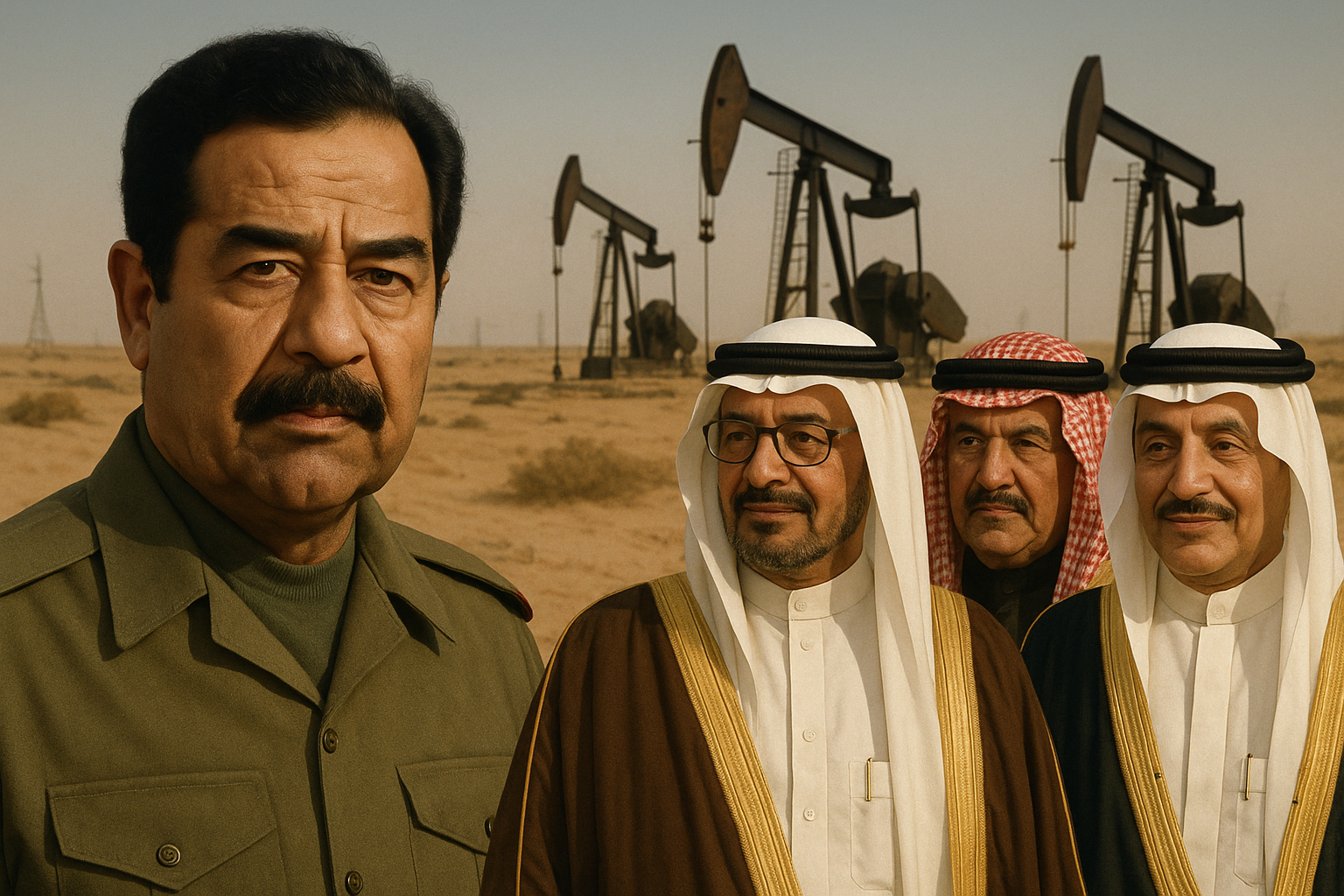
In 1990, Iraq’s President Saddam Hussein invaded Kuwait, accusing it of overproducing oil and “stealing” Iraqi reserves. The real motive? Control of vast oil wealth and regional dominance. The invasion triggered global alarm, threatening not just Kuwait but also the global energy supply.
The United States, under President George H.W. Bush, launched Operation Desert Storm in 1991 — a coalition war that drove Iraqi forces out of Kuwait. It was the most televised war in history, and marked the start of a deeper, longer U.S. military entanglement in the Gulf.
🏰 Enter the Giants – Saudi Aramco
While others faced war and sanctions, Saudi Arabia emerged as the stabilizer — and the gainer. Saudi Aramco, once a U.S.-Saudi joint venture, became fully state-owned by 1980. Today it’s worth trillions and remains the beating heart of global oil pricing.
🌍 Oil, Power & Politics
Oil isn’t just energy — it’s leverage. Control of pipelines, ports, and production means geopolitical clout. The Middle East, holding nearly half the world’s proven reserves, remains the chessboard on which empires still move their pieces.


