
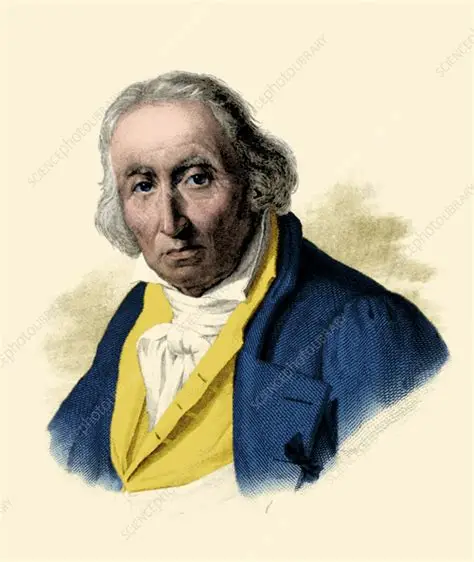
In the attic of Lyon, beneath low wooden beams and the scent of oil and brass, a clockmaker listened to the heartbeat of time. Every tick from his wall of gears echoed with purpose—but Joseph Marie Jacquard heard something deeper. A rhythm waiting to be written, not by hand, but by memory.

Born in 1752 in Lyon, France, Jacquard was the son of a weaver, raised in a world defined by the clatter of looms and the delicate precision of silk. But while others toiled at the warp and weft, Jacquard envisioned something more elegant than even the finest fabric—a way to automate not just the work, but the thought behind the work.
In 1804, he unveiled a device that changed everything: the Jacquard loom. This mechanical marvel used a series of punched cards to control the pattern of threads woven into cloth. Each hole in the card represented a binary choice—thread up, thread down—encoding intricate designs into machine-readable language. The loom didn’t just copy a pattern; it remembered it.
The implications were staggering. Complex designs could now be replicated with machine accuracy, and workers no longer needed to memorize vast sequences or manually adjust the loom with each line. The artisan’s imagination became instructions—repeatable, reliable, and nearly eternal.
Jacquard’s loom was hailed as a marvel, but it also sparked resistance. Some weavers feared for their jobs, smashing the machines in protest. Yet the future could not be unmade. The punch card had arrived—and it would outlive the loom.
A century later, Charles Babbage took inspiration from Jacquard’s design in developing his Analytical Engine, often considered the first conceptual computer. Later, Herman Hollerith would use punched cards to process data for the 1890 U.S. Census, leading to the founding of IBM. What began with silk and thread would ripple into silicon and code.
Today, in the age of quantum computing and neural networks, Jacquard’s legacy remains woven into the circuitry. The machine that could “remember” a pattern was the ancestor of every algorithm we now rely on.
And somewhere, in the echo of a ticking clock and the shuffle of punched cards, Joseph Marie Jacquard still whispers through history—reminding us that all great machines begin with a dream.


